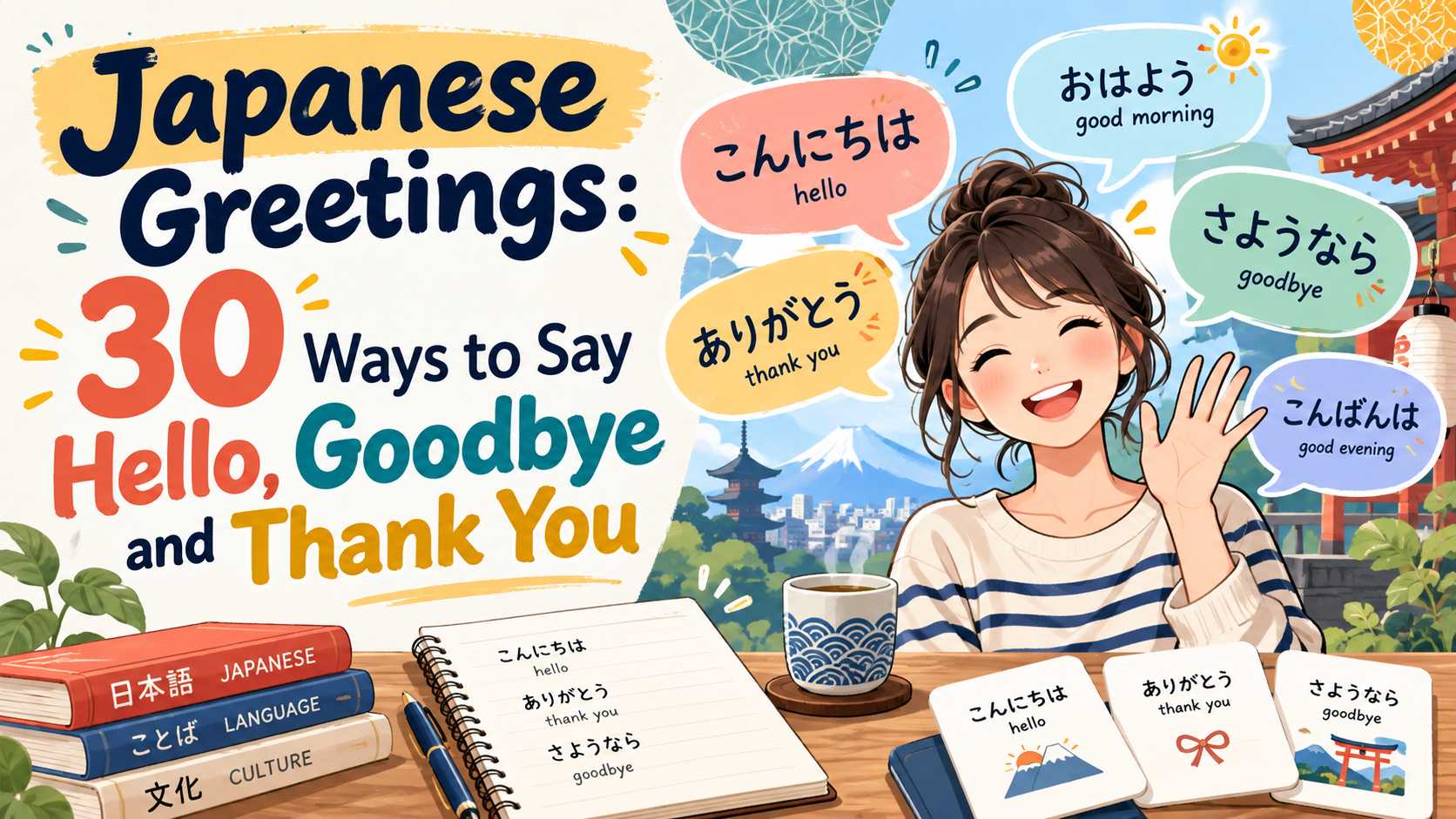
Greetings are the first Japanese most people learn, and also the first place where a textbook answer can sound slightly off. こんにちは is correct, but it is not what a coworker says to you at 8 a.m. さようなら means goodbye, but saying it to a friend can sound oddly heavy.
This guide covers 30 Japanese greetings, with the formality level and the situation each one fits. Nothing here requires grammar study. These are set phrases you can start using immediately.
Casual vs Polite: the One Thing to Understand First
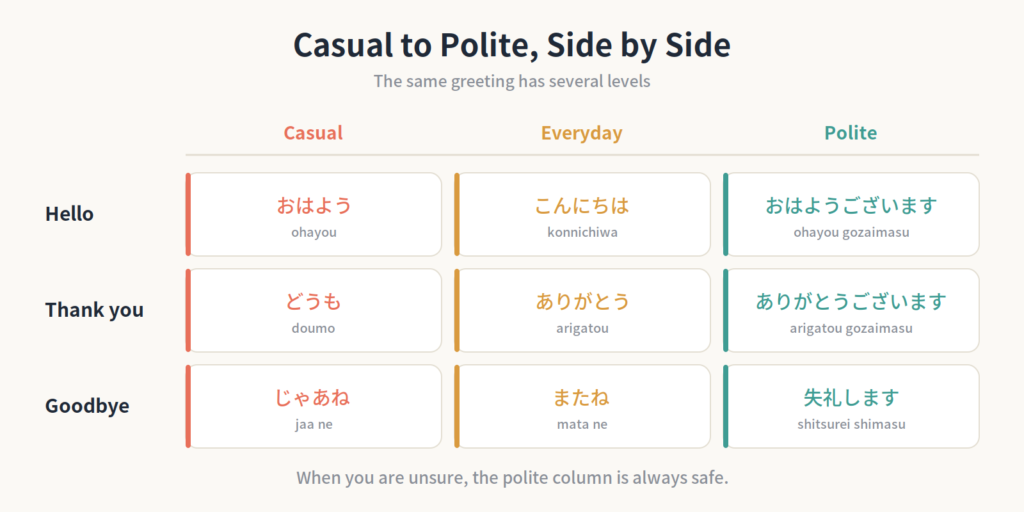
Japanese greetings usually come in pairs: a short casual version and a longer polite one. Most of the time, the polite version is simply the casual one with something added to the end.
| Casual | Polite | Use the polite one with |
|---|---|---|
| おはよう | おはようございます | Coworkers, staff, anyone older |
| ありがとう | ありがとうございます | Anyone serving or helping you |
| お疲れさま | お疲れさまです | Colleagues, especially seniors |
| おやすみ | おやすみなさい | Hosts, in-laws, anyone not close |
If you cannot decide, use the polite form. Being slightly too formal is barely noticeable. Being too casual with a stranger is.
1. Greetings by Time of Day (6)
| Japanese | Meaning, formality and when to use it |
|---|---|
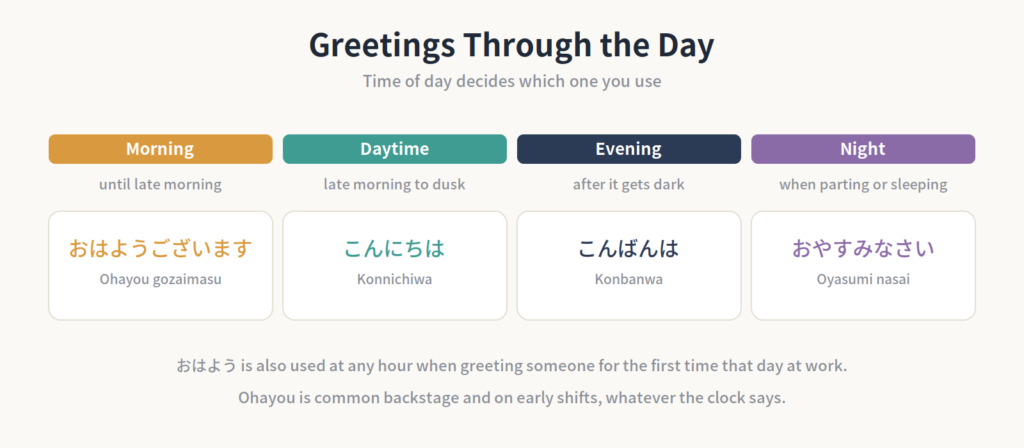
| おはよう Ohayou | Good morning. Casual. Friends, family, people you are close to. |
| おはようございます Ohayou gozaimasu | Good morning. Polite. The default at work, in shops, and with anyone senior. |
| こんにちは Konnichiwa | Hello. / Good afternoon. Neutral. Daytime only. Less common between close friends than textbooks suggest. |
| こんばんは Konbanwa | Good evening. Neutral. Once it is dark. A greeting on arrival, not a goodbye. |
| おやすみ Oyasumi | Good night. Casual. Said when parting at night or going to bed. |
| おやすみなさい Oyasumi nasai | Good night. Polite. Same situations, with people you are not close to. |
One thing that surprises learners: in many workplaces, おはようございます is used the first time you see someone that day, even in the afternoon. It works as “first greeting of my shift” as much as “good morning.”
2. Meeting Someone New (4)
| Japanese | Meaning, formality and when to use it |
|---|---|
| はじめまして Hajimemashite | Nice to meet you. Neutral to polite. Only on a first meeting, as the opening line. |
| よろしくお願いします Yoroshiku onegaishimasu | I look forward to working with you. / Please treat me well. Polite. Closes an introduction, and also follows any request. |
| よろしく Yoroshiku | Same idea, shortened. Casual. Friends and peers only. |
| こちらこそ Kochira koso | Likewise. / Same here. Neutral. The natural reply when someone says よろしく to you first. |
よろしくお願いします has no clean English equivalent. Think of it as “let’s have a good relationship going forward” rather than a specific sentence.
3. Saying Thank You (5)
| Japanese | Meaning, formality and when to use it |
|---|---|
| ありがとう Arigatou | Thanks. Casual. Friends, family, peers. |
| ありがとうございます Arigatou gozaimasu | Thank you. Polite. The safe default for shops, staff, and strangers. |
| どうもありがとうございます Doumo arigatou gozaimasu | Thank you very much. Very polite. For genuine, larger favors. |
| どうも Doumo | Thanks. / Hi. Light and flexible. Quick and friendly, but too breezy for a real favor. |
| すみません Sumimasen | Excuse me. / Sorry. / Thanks for the trouble. Neutral to polite. Thanks someone who went out of their way for you. |
Using すみません to say thank you feels strange in English, but it is extremely common. It acknowledges that the other person took trouble on your behalf, which is often warmer than a plain thanks.
One more detail: when thanking someone for something already finished, ありがとうございました (past form) is common, for example as you leave a restaurant.
4. Responding to Thanks and Apologies (3)
| Japanese | Meaning, formality and when to use it |
|---|---|
| どういたしまして Dou itashimashite | You’re welcome. Polite. Correct, but more formal than most casual situations call for. |
| いえいえ Ie ie | Not at all. / No problem. Casual. What friends actually say most of the time. |
| 大丈夫です Daijoubu desu | It’s fine. / No problem. Neutral. Also declines an offer politely. |
5. Saying Goodbye (7)
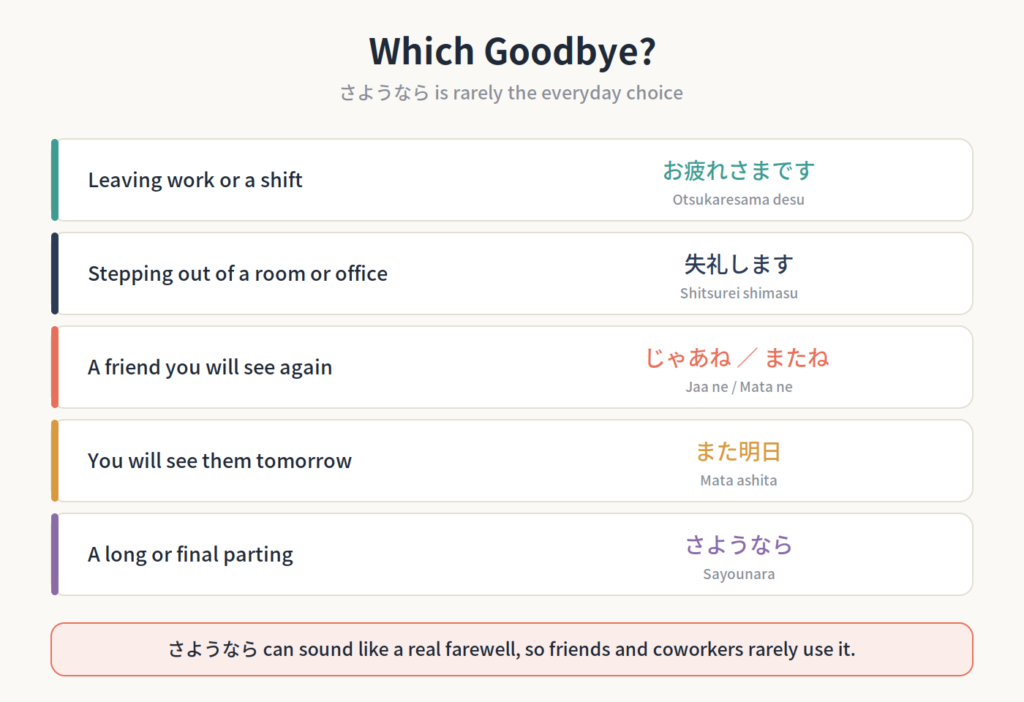
This is the group where textbook Japanese and real Japanese drift apart the most.
| Japanese | Meaning, formality and when to use it |
|---|---|
| またね Mata ne | See you. Casual. Friends, when you expect to meet again. |
| じゃあね Jaa ne | Bye then. Casual. Very common among friends, slightly lighter than またね. |
| また明日 Mata ashita | See you tomorrow. Casual to neutral. Classmates and coworkers at the end of the day. |
| お疲れさま Otsukaresama | Thanks for your work. / See you. Casual. Between colleagues at the same level. |
| お疲れさまです Otsukaresama desu | Same, polite. Polite. The standard way to leave a Japanese workplace. |
| 失礼します Shitsurei shimasu | Excuse me. / I’ll be going now. Polite. Leaving an office, a room, or ending a phone call. |
| さようなら Sayounara | Goodbye. Neutral to formal. A weightier farewell. Also standard between students and teachers at school. |
Why さようなら is not the everyday goodbye
さようなら carries a sense of distance. It suits a parting where you will not see the person for a long time, or where the relationship itself is ending.
That is why adults rarely say it to friends or coworkers they will see tomorrow. It is not rude, just heavier than the moment needs. School is the main exception, where students say it to teachers daily out of routine.
Default to お疲れさまです at work, じゃあね or またね with friends, and 失礼します when you are leaving someone’s space. Save さようなら for real farewells.
6. Coming and Going at Home (4)
| Japanese | Meaning, formality and when to use it |
|---|---|
| いってきます Ittekimasu | I’m off. / I’ll be back. Neutral. Said by the person leaving the house. |
| いってらっしゃい Itterasshai | Take care. / See you later. Neutral. The reply from whoever stays behind. |
| ただいま Tadaima | I’m home. Neutral. Said on arriving back. |
| おかえりなさい Okaerinasai | Welcome back. Neutral. The reply. Shortened to おかえり in casual families. |
These four come in pairs, which makes them easy to learn together. You will also hear them in offices and shops when someone steps out and returns.
7. One Special Case (1)
| Japanese | Meaning, formality and when to use it |
|---|---|
| もしもし Moshi moshi | Hello (on the phone). Casual to neutral. Phone calls only. Never say it to someone in front of you. |
How Greetings Fit Into a Conversation
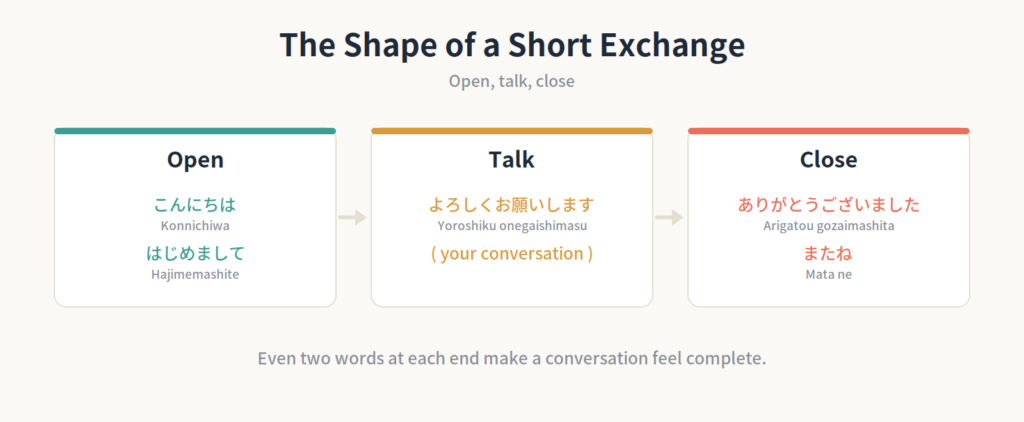
Short exchanges in Japanese tend to have a clear shape: an opening greeting, the actual content, and a closing greeting. Even if the middle is only a few words, having both ends in place makes the whole thing feel natural.
Mini-dialogue 1: arriving at work
You: おはようございます。
Ohayou gozaimasu. $2014 Good morning.Colleague: おはようございます。
Ohayou gozaimasu. $2014 Good morning.You (leaving, hours later): お疲れさまです。
Otsukaresama desu. $2014 Thanks for your work, see you.
Mini-dialogue 2: in a shop
Staff: いらっしゃいませ。
Irasshaimase. $2014 Welcome. (No reply needed.)You: すみません。
Sumimasen. $2014 Excuse me.You (after they help): ありがとうございます。
Arigatou gozaimasu. $2014 Thank you.
Mini-dialogue 3: meeting a friend’s friend
You: はじめまして。よろしくお願いします。
Hajimemashite. Yoroshiku onegaishimasu. $2014 Nice to meet you.Them: こちらこそ、よろしくお願いします。
Kochira koso, yoroshiku onegaishimasu. $2014 Likewise.You (parting): じゃあね。またね。
Jaa ne. Mata ne. $2014 Bye, see you.
Quiz: Which Greeting Should You Use?
Six situations. Pick a greeting for each before checking the answers.
- You arrive at your part-time job at 8 a.m. and see your manager.
- You are leaving the office at the end of the day, past your colleagues.
- A shop assistant spends five minutes finding your size.
- You are saying bye to a friend you will see again on Friday.
- You pick up your phone.
- You are introduced to your friend’s coworker for the first time.
Answers
- おはようございます $2014 polite, and the standard workplace morning greeting.
- お疲れさまです $2014 not さようなら, which would sound far too final.
- ありがとうございます, or すみません to acknowledge the trouble. どうも is too light here.
- またね or じゃあね. また金曜日 (mata kinyoubi, see you Friday) also works.
- もしもし $2014 phone calls only.
- はじめまして, followed by よろしくお願いします.
A Few Notes on Context
- Relationship matters more than age alone. Close colleagues of any age may use casual forms with each other.
- Formality is not fixed. People often start polite and relax as they get to know each other.
- Follow the other person’s lead. If someone greets you casually, matching them is usually safe.
- Regions and workplaces vary. What is normal in one office may be slightly different in another.
- A short greeting said clearly is better than a long one you are unsure of.
Learn the polite version of each greeting first, then pick up the casual versions from people you actually talk to. That order keeps you comfortable in any situation.
Feel Like Getting Your Hands on Some Japanese?
There is a gap between recognizing Japanese and producing it, and closing that gap is oddly satisfying. If you are in the mood to actually type Japanese rather than read about it, our Japanese typing game is an easy place to start. You handle practical Japanese words as you play, through the virtual Japanese keyboard built into the app.
No setup on your side. Your phone’s system language stays where it is, and you do not have to add or change your normal keyboard. QWERTY romaji input is ready if you want the familiar route, and Japanese flick input is there when you feel like trying the layout used across Japan.