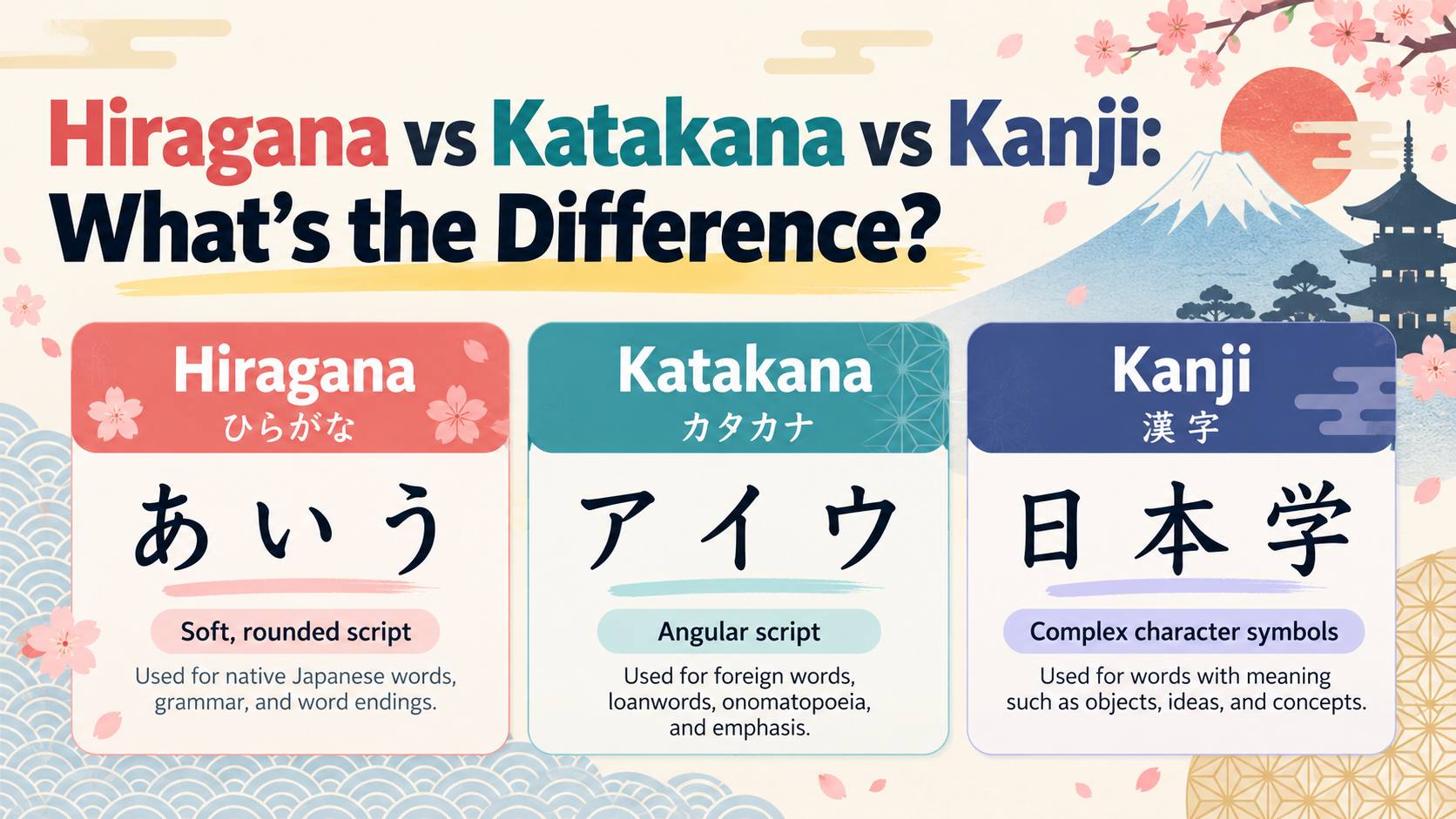
Open a Japanese book, menu, or manga page and you will see three completely different kinds of characters mixed together in the same sentence. Some are round and simple. Some are sharp and angular. Some look like tiny, complicated drawings.
That is not a mistake or a stylistic choice. The Japanese writing system genuinely uses three scripts at once, and each one has a specific job. Once you know what those jobs are, Japanese text stops looking like chaos and starts looking organized.
The Short Answer
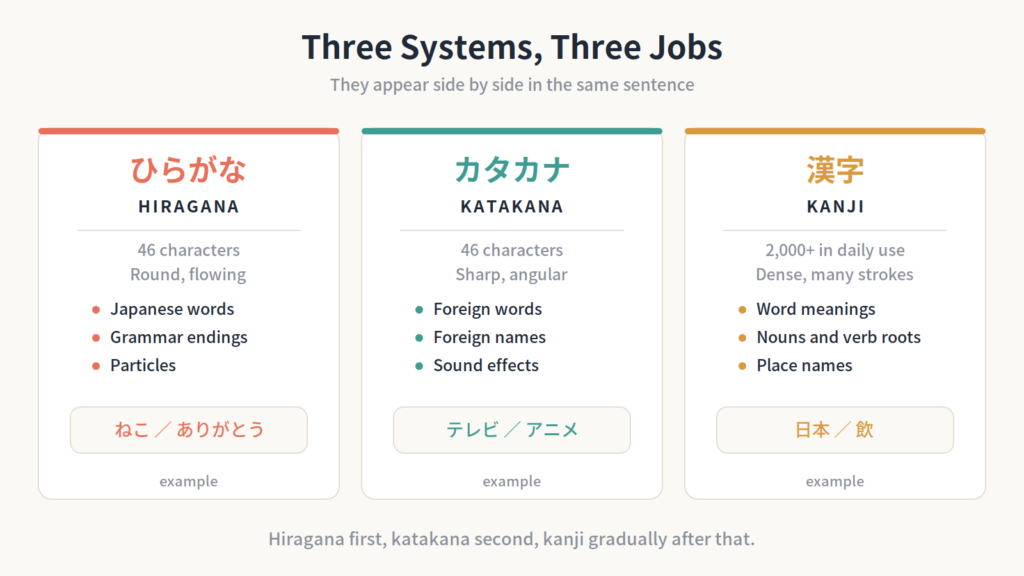
Here is the whole thing in one table. Everything below is just detail.
| Hiragana | Katakana | Kanji | |
|---|---|---|---|
| Looks like | ひらがな | カタカナ | 漢字 |
| Shape | Round, flowing | Sharp, angular | Dense, many strokes |
| How many | 46 basic | 46 basic | 2,000+ in daily use |
| Main job | Japanese words and grammar | Foreign words and names | Meaning of words |
| Example | ねこ (neko) – cat | テレビ (terebi) – TV | 日本 (nihon) – Japan |
What Is Hiragana?
Hiragana is the 46-character script that represents Japanese sounds. Each character equals one sound: あ is “a,” か is “ka,” ね is “ne.”
You can spot it by its shape. Hiragana characters are curvy and soft-looking, with rounded strokes and loops.
Hiragana does three main things:
- It writes native Japanese words, like ねこ (neko) for cat and ありがとう (arigatou) for thank you.
- It writes grammar. The endings that change a verb’s tense or politeness are hiragana.
- It writes particles, the small connecting words that mark who is doing what to whom.
Because it handles grammar, hiragana appears in essentially every Japanese sentence. There is no way around it, which is why it is where beginners start.
What Is Katakana?
Katakana is a second set of 46 characters covering the exact same 46 sounds as hiragana. Same sounds, different shapes. カ is “ka,” ネ is “ne.”
Visually it is the opposite of hiragana: straight lines, sharp corners, fewer curves. Once you have seen both, telling them apart is easy.
Katakana marks a word as coming from somewhere else, or as needing emphasis:
- Foreign loanwords: テレビ (terebi) – TV, コーヒー (koohii) – coffee
- Foreign names, including yours when you write it in Japanese
- Sound effects, which is why manga is full of it
- Emphasis, roughly the way English uses italics
A word like アニメ (anime) is written in katakana even though it feels thoroughly Japanese, because it started life as a shortened English word.
Hiragana vs katakana is not a difference of sound. It is a difference of signal: katakana tells you this word came from outside.
What Is Kanji?
Kanji are characters borrowed from Chinese more than a thousand years ago. Unlike hiragana and katakana, a kanji does not represent a sound. It represents a meaning.
日 means sun or day. 本 means origin or book. Put them together and you get 日本 (nihon), Japan, literally the origin of the sun.
Two things make kanji harder than the kana scripts. There are thousands of them, with around 2,000 used in everyday life. And most of them have more than one reading, so the same character is pronounced differently depending on the word it sits in.
The upside is that kanji carry meaning at a glance. A Japanese reader can scan a page and pick out the content words instantly, because kanji stand out visually from the hiragana around them.
Why Does Japanese Use All Three?
The obvious question: why not simplify and pick one?
The biggest practical reason is that Japanese has a lot of homophones. Many words share the same pronunciation but mean different things. Written only in hiragana, they would be identical on the page. Kanji separates them instantly.
The second reason is spacing. Japanese does not put spaces between words. The mix of scripts does that job instead: kanji marks where a content word starts, and the hiragana around it marks the grammar. Reading a long sentence written only in hiragana is genuinely slow, even for native speakers.
The third is the loanword signal. When you see katakana, you know before you even read the word that it came from another language.
One Sentence, All Three Scripts
Here is a short, completely ordinary Japanese sentence:
私はコーヒーを飲みます。
Watashi wa koohii o nomimasu.
I drink coffee.
Twelve characters, and all three scripts are in there. Here is what each piece is doing.
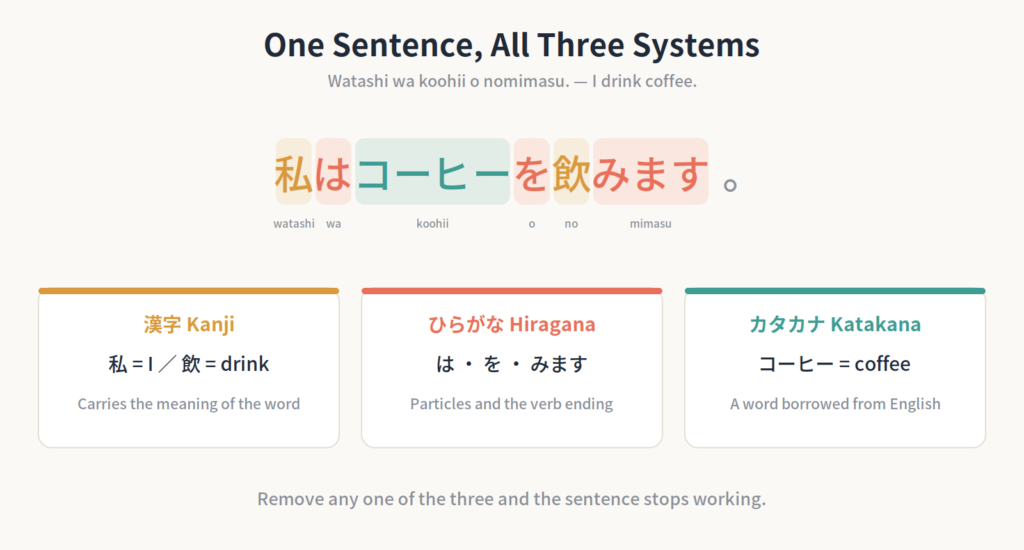
| Part | Script | What it does |
|---|---|---|
| 私 | Kanji | Means “I.” Read watashi here. |
| は | Hiragana | A particle marking the topic. Read wa, not ha. |
| コーヒー | Katakana | koohii, coffee. Katakana because it is a loanword. |
| を | Hiragana | A particle marking the object. Read o. |
| 飲 | Kanji | The core meaning: drink. |
| みます | Hiragana | The polite present-tense ending on the verb. |
Notice the pattern in the verb 飲みます. The kanji holds the meaning, and the hiragana tail does the grammar. That split shows up constantly in Japanese, and recognizing it makes sentences much easier to parse.
Where Does Romaji Fit In?
Romaji is Japanese written with Roman letters: neko, sushi, arigatou. It is not a fourth writing system used in Japan. It is a tool aimed mostly at people who cannot yet read Japanese script, plus a practical way to type Japanese on a keyboard.
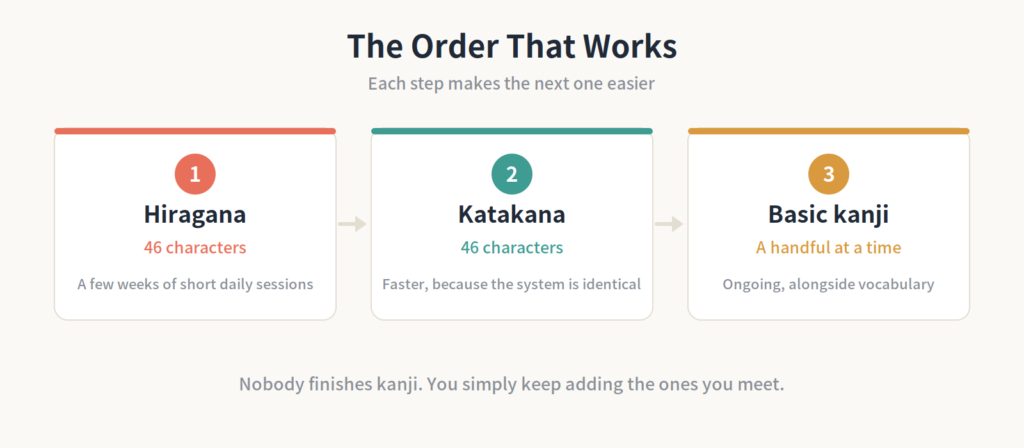
Can you just learn romaji and skip the rest?
For a one-week holiday where you only need to say a few phrases out loud, romaji is fine. For anything beyond that, no.
- Almost nothing in Japan is written in romaji. Menus, signs, packaging, manga, and subtitles all use Japanese script.
- Romaji spellings are inconsistent. し may appear as shi or si, じ as ji or zi.
- Study materials drop romaji quickly. Beyond absolute beginner level, it mostly disappears.
- Reading romaji encourages English-style pronunciation, which gets harder to fix the longer it goes on.
Use romaji as a handrail for the first few weeks, then let go of it. The one place it keeps being genuinely useful is typing, since most people enter Japanese on a keyboard by typing romaji and letting the software convert it.
Which Should You Learn First?
Hiragana, katakana, then kanji. This order is close to universal, and for good reasons.
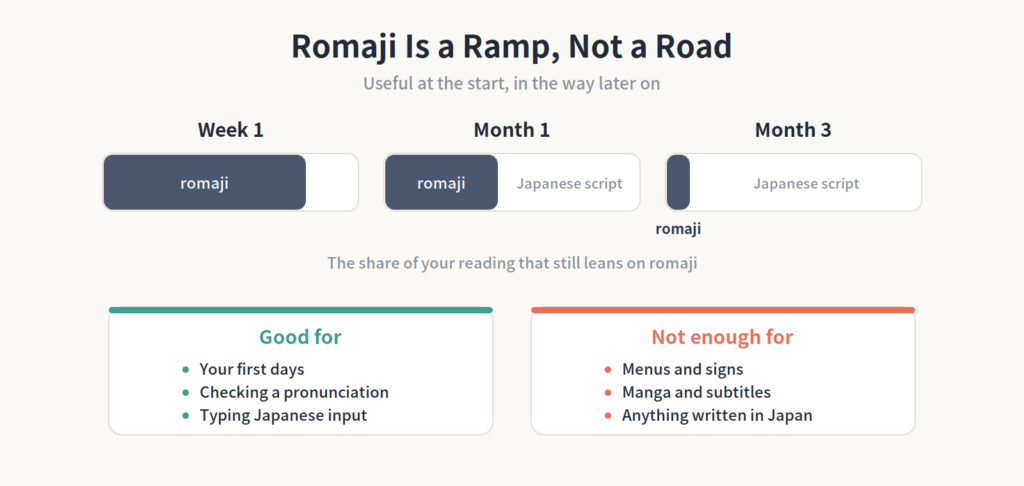
Hiragana comes first because grammar is written in it, so you cannot read a single full sentence without it. It also unlocks furigana, the small hiragana printed above difficult kanji to show their reading.
Katakana comes second and usually goes faster, because the system is identical. Same 46 sounds, new shapes. Many learners find it slightly harder to retain, simply because it appears less often, so expect to review it more.
Kanji comes third, and it never really has a finish line. Rather than sitting down to memorize two thousand characters, learn them a handful at a time as part of the vocabulary you are already studying.
Is Kanji Really Necessary?
It depends on what you want.
If your goal is conversation on a short trip, you can get a long way with spoken phrases and the two kana scripts. Speaking does not require kanji at all.
If you want to read anything, kanji is unavoidable. Ordinary written Japanese is roughly half kanji, and no amount of grammar study substitutes for it. It is also required for JLPT from the very first level.
The reassuring part is that you do not need all of it. A few hundred common kanji cover a large share of everyday text, and the first hundred or so come faster than people expect.
Quick Recap
- Hiragana: 46 rounded characters for Japanese words and all grammar.
- Katakana: 46 angular characters, same sounds, used for foreign words and emphasis.
- Kanji: thousands of meaning-based characters that carry the content of a sentence.
- All three appear together, and each one does a job the others cannot.
- Romaji is temporary support for beginners and a permanent tool for typing.
- Learn hiragana, then katakana, then pick up kanji gradually.
The three scripts look intimidating from the outside. From the inside they are just a division of labor, and the whole thing is far more logical than English spelling.
Curious What It Feels Like to Enter Japanese?
Reading about the scripts is one thing. Producing Japanese yourself feels completely different, and it is a quick way to make all of this concrete. Our Japanese typing game is one simple way to try it: you work with practical Japanese words while playing, using the virtual Japanese keyboard built into the app.
Nothing on your phone has to change first. Your system language stays as it is, and your normal keyboard settings are left alone. QWERTY romaji input is available if you want something familiar, and Japanese flick input is there if you would rather try the layout used across Japan.