If you have ever looked at Japanese writing and felt completely lost, you are not alone. The good news is that Japanese has a friendly starting point, and it is called hiragana. Almost every Japanese learner begins here, whether they are studying for a trip, trying to read manga, or planning to take the JLPT someday.
Hiragana has only 46 basic characters, and each one has a fixed sound. That means you can go from “this looks impossible” to “I can sound this out” faster than you might expect. This guide walks you through what hiragana is, how it works, and exactly how to learn it, step by step.
What Is Hiragana?
Hiragana is a set of 46 basic characters used to write Japanese sounds. People often call it the “Japanese alphabet,” and that phrase is close enough for everyday use, but there is one important difference.
In English, a single letter like “k” does not make a complete sound on its own. In hiragana, each character already contains a full sound. The character か is not “k” — it is “ka.” The character ね is “ne.” This makes hiragana a syllabary rather than an alphabet.
That difference works in your favor. Once you know what a character sounds like, it sounds that way almost every time. Japanese pronunciation is far more consistent than English spelling, where “though,” “through,” and “tough” all behave differently.
One character, one sound. Learn the 46 basic characters and you can read the sound of almost any Japanese word written in hiragana — even before you know what it means.
Why Does Japanese Use Hiragana?
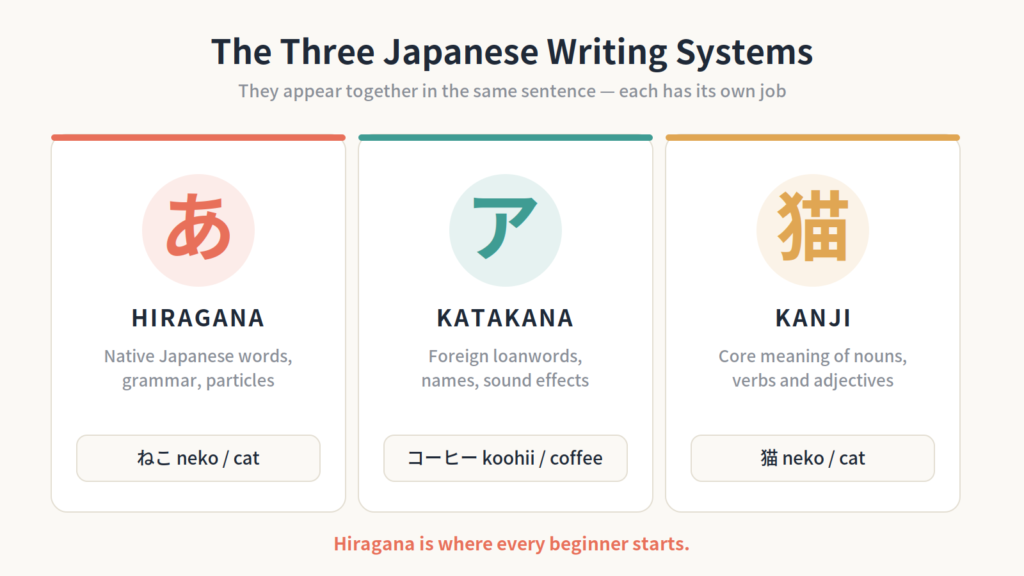
Written Japanese mixes three systems in the same sentence. This sounds strange at first, but each one has a clear job.
| System | Look | Main job | Example |
|---|---|---|---|
| Hiragana | Round and curvy | Native Japanese words, grammar endings, small connecting words | ねこ (neko) – cat |
| Katakana | Sharp and angular | Foreign loanwords, foreign names, sound effects | コーヒー (koohii) – coffee |
| Kanji | Complex, built from strokes | Core meaning of nouns, verbs, and adjectives | 猫 (neko) – cat |
Hiragana is the glue. It holds sentences together, marks grammar, and can spell out any Japanese word when a kanji is unknown or unnecessary. Children’s books are written almost entirely in hiragana, and beginner textbooks lean on it heavily.
There is also a practical reason to learn hiragana first: it unlocks the other two. Kanji are often printed with tiny hiragana above them, called furigana, which tell you how to read them. Without hiragana, that helpful hint is useless to you.
The 46 Basic Hiragana Characters
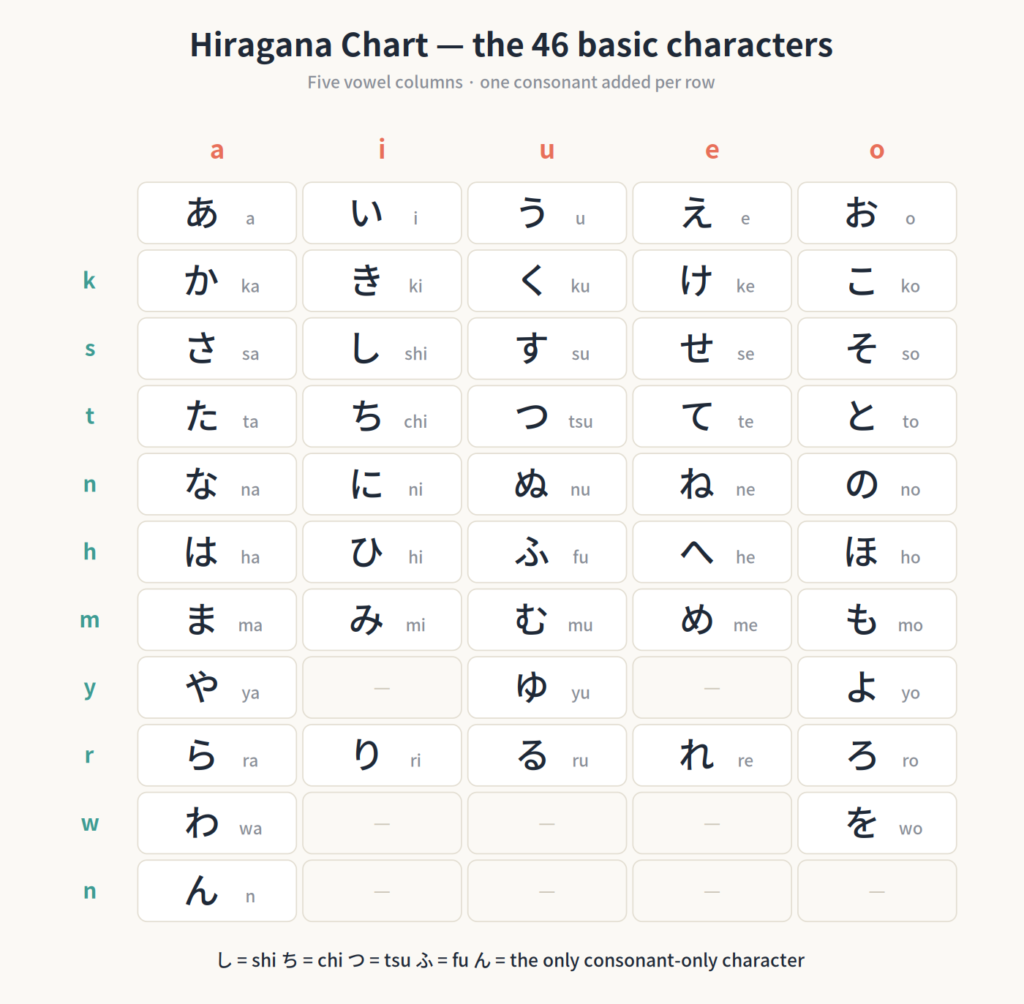
Here is a beginner-friendly hiragana chart. Read it left to right, row by row. The romaji in parentheses shows the approximate sound.
| Row | a | i | u | e | o |
|---|---|---|---|---|---|
| vowels | あ (a) | い (i) | う (u) | え (e) | お (o) |
| k | か (ka) | き (ki) | く (ku) | け (ke) | こ (ko) |
| s | さ (sa) | し (shi) | す (su) | せ (se) | そ (so) |
| t | た (ta) | ち (chi) | つ (tsu) | て (te) | と (to) |
| n | な (na) | に (ni) | ぬ (nu) | ね (ne) | の (no) |
| h | は (ha) | ひ (hi) | ふ (fu) | へ (he) | ほ (ho) |
| m | ま (ma) | み (mi) | む (mu) | め (me) | も (mo) |
| y | や (ya) | — | ゆ (yu) | — | よ (yo) |
| r | ら (ra) | り (ri) | る (ru) | れ (re) | ろ (ro) |
| w | わ (wa) | — | — | — | を (wo) |
| n | ん (n) | — | — | — | — |
How the chart is organized
Notice the pattern. The five columns are the five vowel sounds: a, i, u, e, o. Every row after the first adds one consonant to those same five vowels. The k row gives you ka, ki, ku, ke, ko. The m row gives you ma, mi, mu, me, mo.
Once you see this grid logic, hiragana stops feeling like 46 random shapes and starts feeling like a small, orderly system.
- Three rows are incomplete: the y row and w row skip some vowels.
- を (wo) is pronounced like “o” and is used almost exclusively as a grammar marker.
- ん (n) is the only character that is a single consonant sound with no vowel attached.
Basic Hiragana Pronunciation
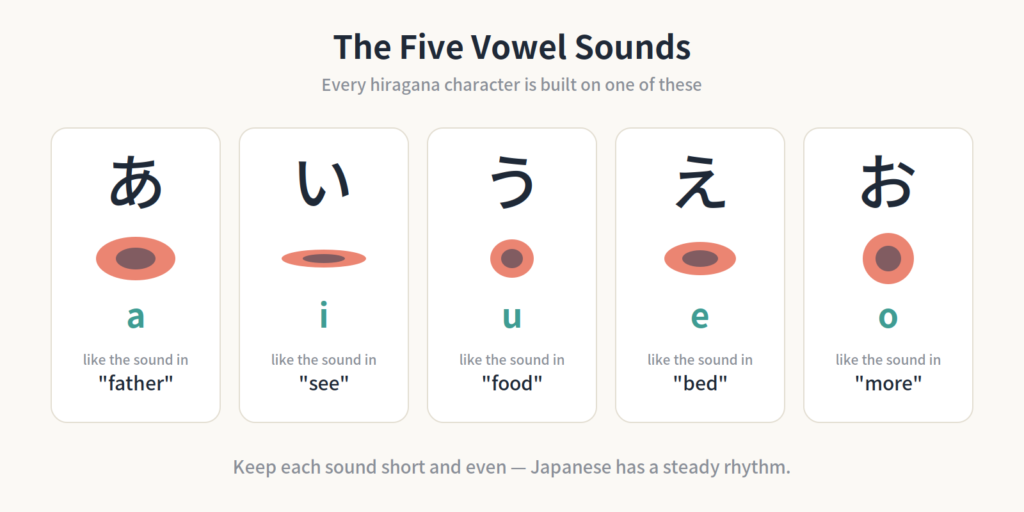
Everything starts with the five vowels. Say them clearly and hold them short and even.
| Character | Romaji | Close English sound |
|---|---|---|
| あ | a | the “a” in father |
| い | i | the “ee” in see, but shorter |
| う | u | the “oo” in food, with relaxed lips |
| え | e | the “e” in bed |
| お | o | the “o” in more |
Most rows behave exactly as the grid suggests, but a handful of characters break the pattern slightly. These are worth memorizing early because beginners mispronounce them constantly.
- し is shi, not “si”
- ち is chi, not “ti”
- つ is tsu, not “tu” — the “ts” sound in “cats”
- ふ is fu, a soft sound between “fu” and “hu”
- ら り る れ ろ are somewhere between English “r” and “l” — a light tap of the tongue
One more habit to build: give every character roughly the same length. Japanese has a steady, even rhythm. ありがとう (arigatou) is five beats — a-ri-ga-to-u — not “AH-rig-a-toh.”
Hiragana and Romaji: How They Relate
Romaji means Japanese written with Roman letters. When you see ねこ written as “neko,” that is romaji.
Romaji is genuinely useful at the very beginning. It gives you a handrail while your eyes are still adjusting to unfamiliar shapes. But it is a bridge, not a destination, and there are two reasons to cross it fairly quickly.
- Real Japanese does not use it. Menus, signs, manga, and subtitles are written in Japanese script.
- Spellings vary. し can be written as “shi” or “si” depending on the romanization system. じ may appear as “ji” or “zi.” Hiragana itself has no such ambiguity.
A useful rule of thumb: use romaji to check yourself, not to read. Look at the hiragana first, guess the sound, then confirm.
Dakuten and Handakuten: Two Tiny Marks
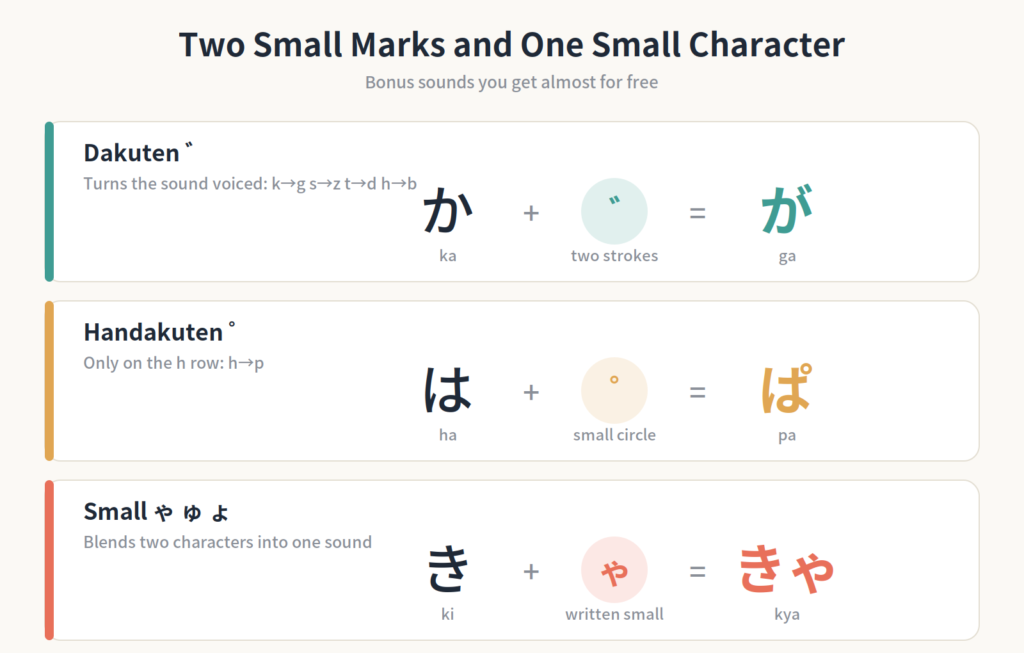
Once you know the 46 basics, you get a large bonus set almost for free. Two small marks attach to the upper right of certain characters and change the consonant sound.
- Dakuten (two short strokes, like a quotation mark) makes the sound “voiced” — softer and buzzier.
- Handakuten (a small circle) applies only to the h row and turns it into a p sound.
| Base row | With dakuten | Sounds |
|---|---|---|
| か き く け こ (k) | が ぎ ぐ げ ご | ga gi gu ge go |
| さ し す せ そ (s) | ざ じ ず ぜ ぞ | za ji zu ze zo |
| た ち つ て と (t) | だ ぢ づ で ど | da ji zu de do |
| は ひ ふ へ ほ (h) | ば び ぶ べ ぼ | ba bi bu be bo |
| は ひ ふ へ ほ (h) | ぱ ぴ ぷ ぺ ぽ | pa pi pu pe po |
You do not need to memorize these as new characters. If you know か is “ka,” then が is simply “ga.” Examples: かばん (kaban) – bag, ぱん (pan) – bread, でんわ (denwa) – telephone.
Small ゃ, ゅ, and ょ
When や, ゆ, or よ are written in a smaller size after a character from the “i” column, the two characters blend into a single blended sound. Compare きや (ki-ya, two beats) with きゃ (kya, one blended sound).
| Base | + ゃ | + ゅ | + ょ |
|---|---|---|---|
| き | きゃ (kya) | きゅ (kyu) | きょ (kyo) |
| し | しゃ (sha) | しゅ (shu) | しょ (sho) |
| ち | ちゃ (cha) | ちゅ (chu) | ちょ (cho) |
| に | にゃ (nya) | にゅ (nyu) | にょ (nyo) |
| ひ | ひゃ (hya) | ひゅ (hyu) | ひょ (hyo) |
| り | りゃ (rya) | りゅ (ryu) | りょ (ryo) |
| じ | じゃ (ja) | じゅ (ju) | じょ (jo) |
Examples you will meet early: おちゃ (ocha) – green tea, りょこう (ryokou) – travel, しゃしん (shashin) – photograph.
Small っ: The Little Pause
A small つ does not make a sound of its own. Instead, it creates a brief stop before the next consonant, like the catch in the middle of the English phrase “hot tea.”
- きて (kite) – come here → きって (kitte) – postage stamp
- がっこう (gakkou) – school
- ちょっと (chotto) – a little
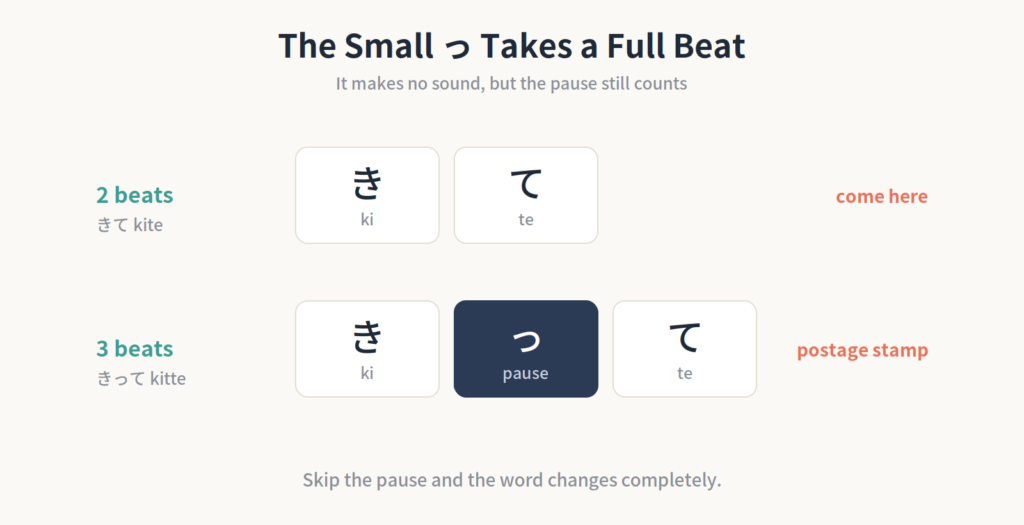
Here is the key point: the pause takes up a full beat. きって is not two beats plus a hiccup — it is three beats, with the second one being silence. Skipping it changes the word entirely, which is why beginners sometimes say “stamp” when they mean “come.”
Long Vowels
Japanese also stretches vowels, and the length matters. A long vowel is simply written by adding another vowel character.
| Pattern | Example | Meaning |
|---|---|---|
| あ + あ | おかあさん (okaasan) | mother |
| い + い | おにいさん (oniisan) | older brother |
| う + う | ゆうき (yuuki) | courage |
| え + い | せんせい (sensei) | teacher |
| お + う | こうこう (koukou) | high school |
Two useful notes. The え sound is usually extended with い rather than another え, and the お sound is usually extended with う rather than another お. There are a small number of exceptions, such as こおり (koori) – ice, but you can learn those individually as you meet them.
Common Mistakes Beginners Make
Mixing up look-alike characters
Some pairs really do look similar at small sizes. Studying them side by side is far more effective than meeting them separately and getting confused later.
| Easily confused | How to tell them apart |
|---|---|
| ぬ (nu) / め (me) | ぬ has a loop at the end; め does not |
| れ (re) / わ (wa) / ね (ne) | Look at the tail: れ hooks out, わ curves in, ね loops fully |
| さ (sa) / ち (chi) | They face opposite directions |
| る (ru) / ろ (ro) | る ends in a loop; ろ ends open |
| は (ha) / ほ (ho) | ほ has one extra horizontal stroke |
| つ (tsu) / し (shi) | つ curves horizontally; し curves vertically |
Other frequent slip-ups
- Leaning on romaji too long. If romaji is still your first read after a few weeks, cover it up.
- Ignoring character size. っ and つ are the same shape. Only the size tells you which one it is.
- Forgetting the particle exceptions. When は, へ, and を are used as grammar markers, they are read “wa,” “e,” and “o.” Everywhere else, は is “ha” and へ is “he.”
- Perfecting handwriting before reading. Neat stroke order is a nice skill, but recognition is what lets you actually read things.
- Trying to learn all 46 in one sitting. Five to ten per session works much better.
Effective Ways to Memorize Hiragana
1. Learn in small chunks, row by row
Do not attack the whole chart. Take one row at a time: the five vowels first, then the k row, then the s row. Each row is only five characters, and the vowel endings repeat, so the load stays light.
2. Use mnemonics that connect shape to sound
Silly mental pictures stick. き (ki) looks a bit like a key. ね (ne) can look like a cat curling its tail, and ねこ (neko) means cat. め (me) can look like an eye, and “me” is about looking. It does not matter whether your mnemonic makes sense to anyone else.
3. Write by hand, at least at first
Writing forces you to notice details like which direction a curve turns. You do not need calligraphy. Five repetitions of each new character, while saying the sound out loud, is plenty.
4. Read real words as soon as possible
Isolated characters are boring and forgettable. As soon as you know a few rows, start reading short words. Recognizing すし (sushi) on a chart feels like a small victory, and small victories keep people going.
5. Review with spaced repetition
Flashcards that show you difficult characters more often and easy ones less often are the most efficient way to review. Paper cards work fine too. The important part is short, frequent sessions rather than rare long ones.
6. Practice input, not just reading
Producing a character is a different skill from recognizing one. Typing or writing Japanese, even slowly, tests your memory in a way that passive reading does not.
A Simple Beginner Study Routine
Here is a routine that fits into about fifteen minutes a day. Many learners finish hiragana in two to four weeks with this pace.
| Week | New material | Daily focus |
|---|---|---|
| Week 1 | Vowels, k row, s row | Write each new character 5 times, then review everything learned so far |
| Week 2 | t, n, h, m rows | Add flashcard review of earlier rows; start reading 3-letter words |
| Week 3 | y, r, w rows and ん | Focus extra time on look-alike pairs |
| Week 4 | Dakuten, handakuten, small kana | Read short sentences; practice typing or writing words from memory |
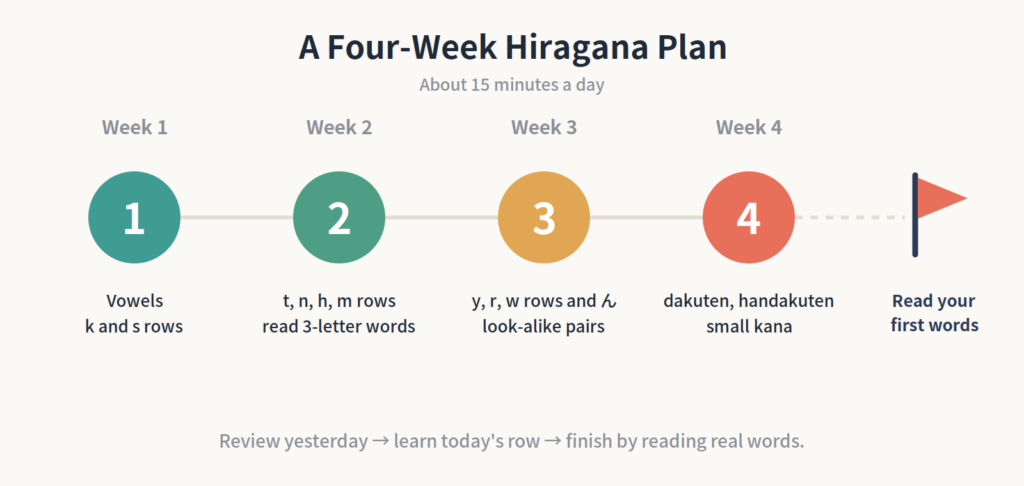
Within each session, follow the same three steps: review yesterday’s characters first, learn the new ones second, and finish by reading a few real words. Ending on something you can actually read makes the next session easier to start.
Easy Japanese Words Written in Hiragana
Reading practice is where hiragana starts to feel real. Try covering the romaji column and sounding each word out first.
| Hiragana | Romaji | Meaning |
|---|---|---|
| ねこ | neko | cat |
| いぬ | inu | dog |
| すし | sushi | sushi |
| さくら | sakura | cherry blossom |
| ありがとう | arigatou | thank you |
| おはよう | ohayou | good morning |
| みず | mizu | water |
| やま | yama | mountain |
| うみ | umi | sea |
| ともだち | tomodachi | friend |
| がっこう | gakkou | school |
| でんしゃ | densha | train |
Practice Section
Work through these three short exercises. They take about ten minutes total and cover reading, sound length, and recall.
Exercise 1: Sound it out
Read each word aloud, one character at a time, before checking the romaji in the table above: ねこ / うみ / やま / みず / さくら
Exercise 2: Count the beats
Clap once per beat as you say each word. Remember that a small っ gets its own beat and a long vowel gets an extra one.
- がっこう → 4 beats (ga-[pause]-ko-u)
- ありがとう → 5 beats
- ちょっと → 3 beats (cho-[pause]-to)
Exercise 3: Write from memory
Without looking at the chart, write the hiragana for these sounds: ne, ko, su, shi, ya, ma. Then check your answers. Whatever you got wrong is exactly what to review tomorrow.
Quick Reading Quiz
Five questions. Read each one and write down your answer before scrolling.
- What does いぬ mean?
- How do you read さくら?
- Which of these two means “postage stamp”: きて or きって?
- What sound does が make?
- How many beats are in ありがとう?
Answers
- Dog (inu)
- sakura — cherry blossom
- きって (kitte). きて (kite) means “come here.”
- “ga” — it is か (ka) with dakuten
- Five (a-ri-ga-to-u)
What Comes After Hiragana?
Once hiragana feels comfortable, katakana is the natural next step, and it is usually faster because the system is identical — same 46 sounds, different shapes. After that, you can start picking up basic kanji and simple grammar, which is roughly where JLPT N5 preparation begins.
You do not need to wait until you are perfect. Reading slowly with occasional mistakes is normal and useful. Every sign, menu, and manga panel you decode gets a little easier than the last one.
Curious About Typing Japanese?
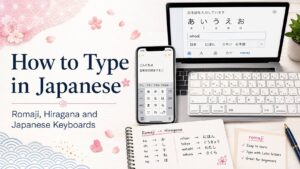
Reading hiragana is one thing. Producing it is another, and it is a surprisingly fun way to test what has actually stuck. Our Japanese typing game lets you play with real Japanese words instead of only reading about them, with its own virtual Japanese keyboard built into the app.
There is nothing to set up first. You do not need to switch your phone’s system language or add a Japanese keyboard to your device settings. QWERTY romaji input is available if you want something familiar, and you can also try flick input — the swipe-based method most people in Japan use to type on their phones.

コメント