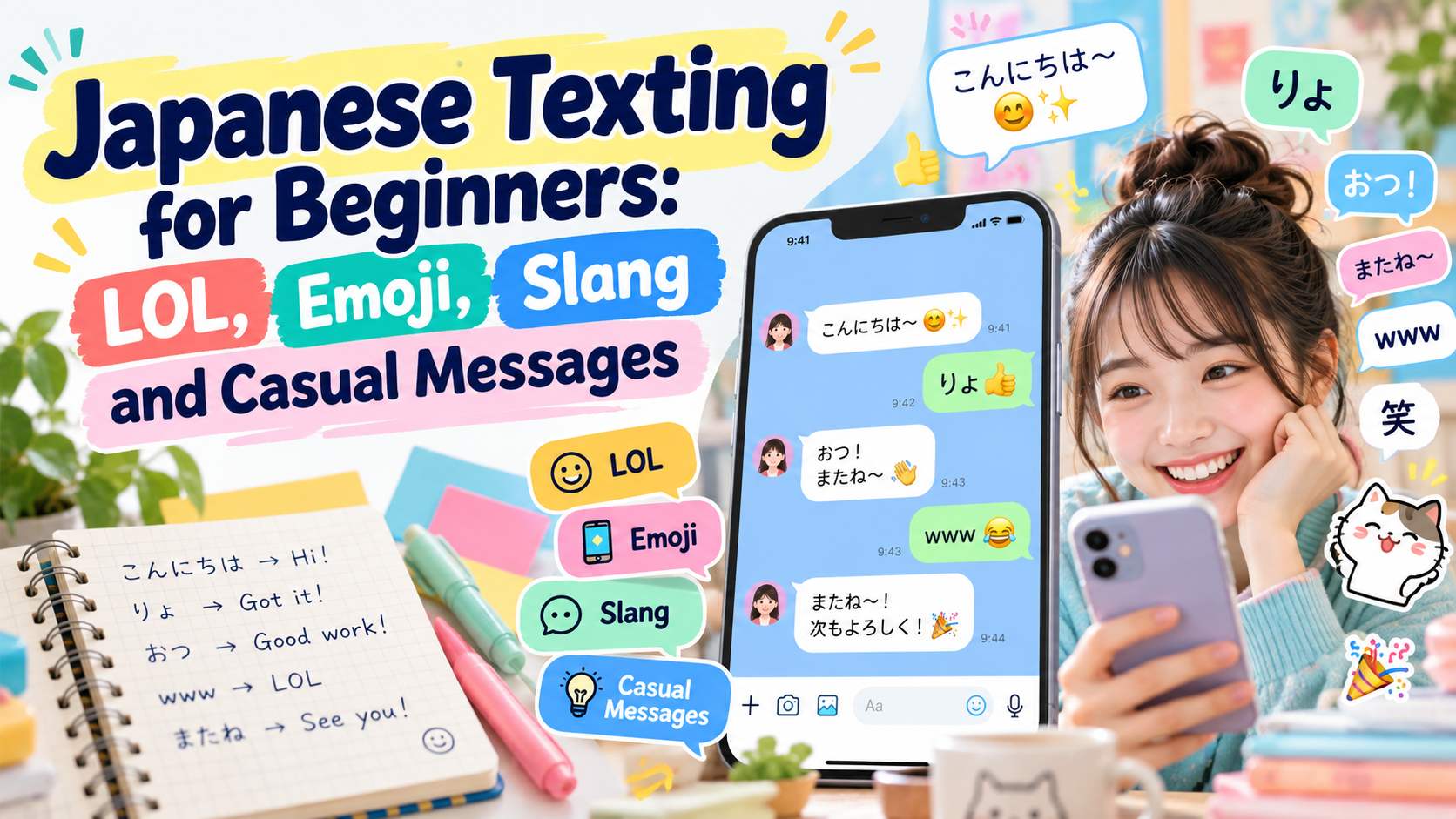
You study some Japanese, you feel like you are getting somewhere, and then someone sends you a message that reads りょ!www and you are completely lost again.
Written Japanese in chats, games, and social media follows different rules from the Japanese in textbooks. Words get chopped in half, politeness mostly disappears, and a row of the letter w somehow means laughing.
This guide covers the Japanese texting slang you will actually run into, what each piece signals about tone, and where the line sits between friendly and too casual.
Casual vs Polite, in Writing
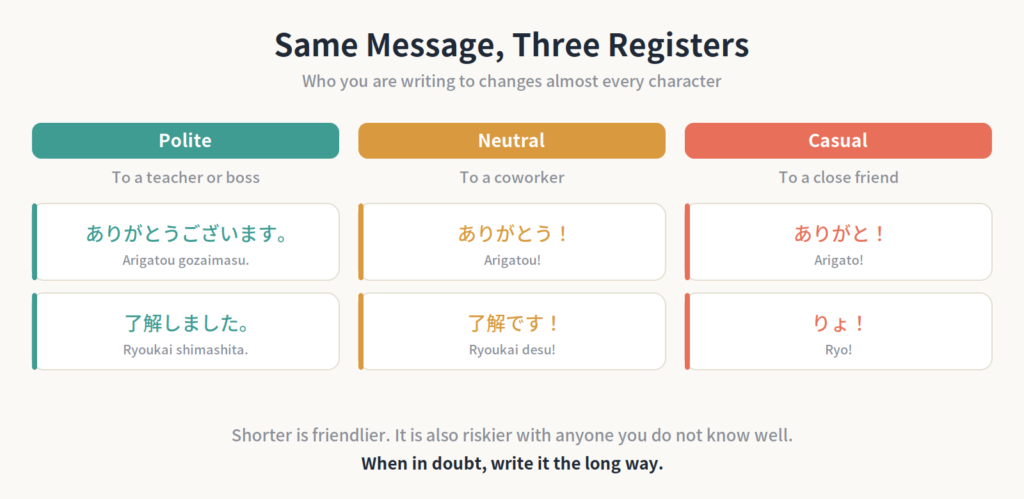
Spoken Japanese adjusts to the listener, and written Japanese does the same thing, only more visibly. The same message to three different people can look almost unrecognizable.
| Who you’re writing to | What changes |
|---|---|
| Teacher, boss, a company | Full polite endings (です / ます), proper punctuation, no slang, no emoji. |
| Coworker or acquaintance | Polite endings but shorter sentences. A ! or a light emoji is fine. |
| Close friend | Plain forms, shortened words, 笑 or www, emoji and stickers. |
Casual Japanese is not a beginner version of polite Japanese. It is a separate register, and using it with the wrong person reads as over-familiar rather than friendly.
Why Everything Gets Shorter
Typing Japanese takes effort, and casual writing trims anything it can. Once you see the pattern, most shortened forms become guessable.
| Full form | Short form and how it reads |
|---|---|
| ありがとうございます Arigatou gozaimasu | ありがとう → ありがと! → ありがとー Each step is friendlier and more casual. |
| 了解しました Ryoukai shimashita | 了解!→ りょ! りょ is very casual and mostly used by younger speakers. |
| お疲れさまです Otsukaresama desu | おつかれ!→ おつ! A general “hi” or “bye” in work and gaming groups. |
| おはようございます Ohayou gozaimasu | おはよう → おはよ! Dropping the final う is standard in chat. |
| ごめんなさい Gomen nasai | ごめん → ごめんね ね softens it, so ごめんね sounds warmer than ごめん. |
You will also see the long vowel mark ー used where a textbook would write a vowel: ありがとー instead of ありがとう. It stretches the word and makes it sound relaxed.
What 笑 and www Actually Mean
These two are the Japanese internet slang equivalent of lol, and they come from the same source.
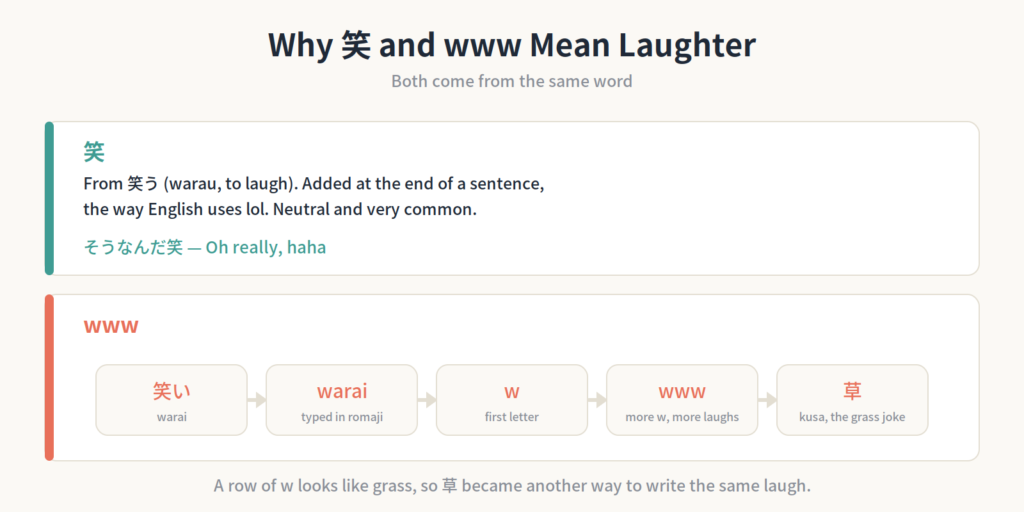
笑 is the kanji for laughing, tacked onto the end of a sentence. そうなんだ笑 reads roughly as “oh really, haha.” It is neutral and works in most casual messages.
www comes from typing 笑い (warai) in romaji and keeping only the first letter. One w is a small laugh. More w means a bigger one. Because a long row of w looks a bit like grass growing, 草 (kusa, grass) became yet another way to write the same thing.
| Marker | Feel |
|---|---|
| 笑 | Mild, safe, widely used by all ages. |
| w | A small chuckle. Common in games and forums. |
| www | Genuinely funny. More w, more laughter. |
| 草 | Internet-native and playful. Fine with friends, odd with a coworker. |
| (笑) | The older bracketed form. Slightly more formal-looking. |
Use 笑 when you are unsure. www and 草 are fine with friends, but they mark a message as clearly informal.
Emoji, Kaomoji and Stickers
Emoji were invented in Japan, and they still do heavy lifting in Japanese chat. They are not decoration. They carry tone that the words themselves leave out.
Alongside emoji you will meet kaomoji, the sideways-free faces made from regular characters. Unlike Western emoticons, they are read upright, so the eyes come first.
| Kaomoji | What it conveys |
|---|---|
| (^^) or (^_^) | A friendly smile. Very common and safe. |
| (>_<) | Frustration, embarrassment, or a wince. |
| (T_T) | Crying, often exaggerated for effect. |
| m(_ _)m | A bowing figure. An apology or a thank you. |
Stickers are the third layer. In many Japanese group chats a sticker counts as a complete reply, and sending one instead of typing is entirely normal.
The Softening Toolkit
Here is the single most useful thing to understand about Japanese texting: a bare word can read as cold, even when the content is neutral.
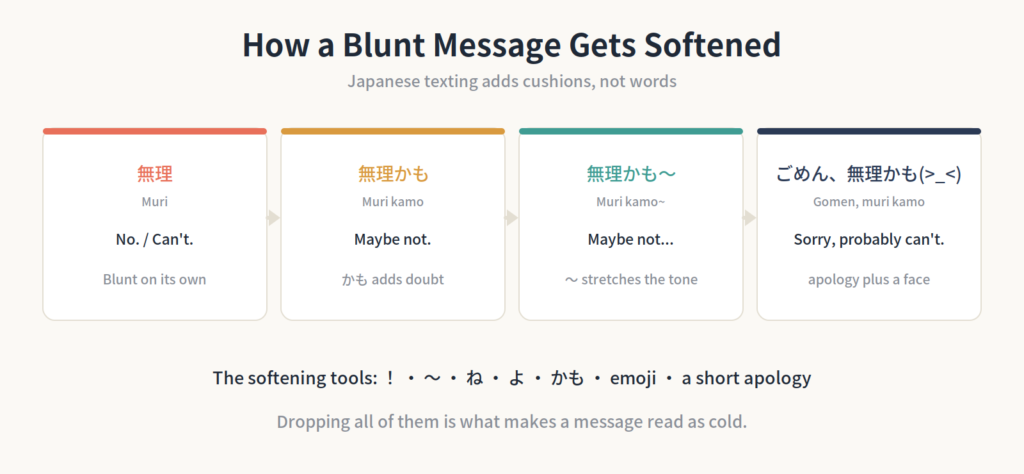
Japanese does not soften by adding polite words here. It softens by adding small signals: かも (maybe), a stretched ー or 〜, a final ね or よ, a short apology, or a face.
This also explains a common beginner problem. A learner writes correct, plain Japanese with no softeners, and it comes across as blunt or annoyed. The grammar is fine. The cushions are missing.
Japanese Chat Phrases You’ll See Constantly
| Japanese | Meaning and tone |
|---|---|
| おはよ! Ohayo! | Morning! Casual. |
| おつかれ!/ おつ! Otsukare! / Otsu! | Nice work! Used as hello and goodbye in work and gaming chats. |
| ありがと! Arigato! | Thanks! Casual and warm. |
| 了解!/ りょ! Ryoukai! / Ryo! | Got it! りょ is very casual. |
| おけ!/ おっけー Oke! / Okkee | OK! Borrowed from English, fully casual. |
| 大丈夫? Daijoubu? | You okay? Also “is this okay?” Neutral. |
| 今何してる? Ima nani shiteru? | What are you up to? Casual, friends only. |
| ごめん/ごめんね Gomen / Gomen ne | Sorry. ごめんね is softer. |
| マジ? Maji? | Seriously? Casual, slightly slangy. |
| ほんと? Honto? | Really? Neutral and safer than マジ?. |
| そうなんだ Sou nanda | Oh, I see. A gentle acknowledgment. |
| だよね Da yo ne | Right? / I know. Agreement, casual. |
| わかる Wakaru | I get it. / Same. Strong agreement. |
| いいね! Ii ne! | Nice! Also the word on a like button. |
| なるほど Naruhodo | I see. Works in casual and work chat alike. |
| またね!/ じゃ! Mata ne! / Ja! | See you! じゃ is the shortest goodbye there is. |
| ちょっと待って Chotto matte | Hang on a sec. Casual. |
| よろしく! Yoroshiku! | Thanks in advance. Ends a request naturally. |
Example Conversations
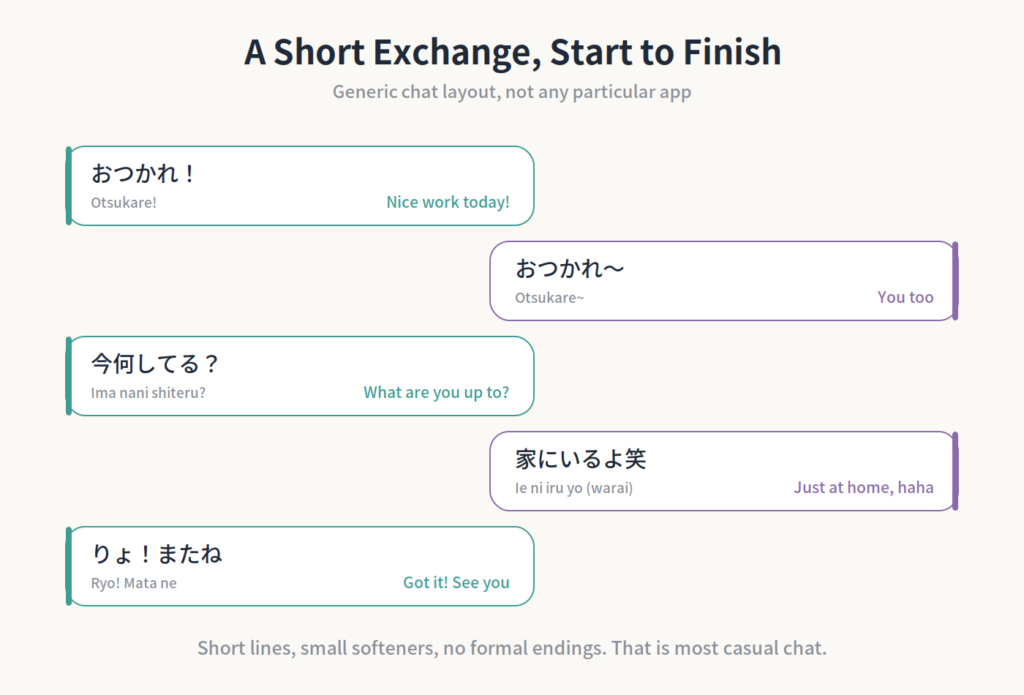
Chat 1: making plans with a friend
A: 今何してる?
Ima nani shiteru? — What are you up to?B: 家にいるよ〜
Ie ni iru yo~ — Just at home.A: 明日ひま?
Ashita hima? — Free tomorrow?B: ひまー!何かする?
Hima—! Nanika suru? — Totally free! Want to do something?A: りょ!また連絡するね
Ryo! Mata renraku suru ne — Got it! I’ll message you.
Chat 2: turning something down
A: 今夜ごはん行かない?
Konya gohan ikanai? — Want to grab dinner tonight?B: ごめん、今日はちょっと無理かも(>_<)
Gomen, kyou wa chotto muri kamo — Sorry, tonight might not work.A: 了解!また今度ね
Ryoukai! Mata kondo ne — No problem! Next time.
Notice how B never actually says no. ごめん, ちょっと, and かも do the work, and that indirectness is the normal, polite way to decline.
Chat 3: the same situation at work
Colleague: 資料、明日までにお願いできますか?
Shiryou, ashita made ni onegai dekimasu ka? — Could I get the documents by tomorrow?You: 承知しました。明日の午前中にお送りします。
Shouchi shimashita. Ashita no gozenchuu ni ookuri shimasu. — Understood. I’ll send them tomorrow morning.Colleague: ありがとうございます!
Arigatou gozaimasu! — Thank you!
Same medium, completely different writing. No shortening, no 笑, full polite endings. This is why register matters more than vocabulary in Japanese chat.
Use These Carefully
- りょ, おつ, 草 — very casual and generation-flavored. Great with friends, jarring in a work chat.
- マジ? — fine among friends, but ほんと? is the safer equivalent with anyone else.
- Plain forms with someone new — dropping です and ます too early is the most common misstep learners make.
- Bare one-word replies — 無理 or いや alone reads as cold. Add a softener.
- Heavy slang copied from social media — some of it is tied to a specific community, and using it outside that context stands out.
A practical rule: match the other person. If they write to you in polite Japanese, answer in polite Japanese until they loosen up first.
Online Language Keeps Moving
Everything in this article is current as of writing, and some of it will feel dated eventually. That is normal for internet slang in any language.
Some expressions here have been stable for years. 笑 and おつかれ are not going anywhere. Others move faster, and a phrase that is everywhere on one platform may be unknown on another, or may quietly mark the age of the person using it.
The reliable approach is to read more than you write at first. Watch how the people you actually talk to phrase things, then borrow from them. That gets you current slang without the risk of using something that has already aged out.
Ready to Type Some of This Yourself?
Reading Japanese messages is one skill. Producing them on a keyboard is another, and it is the one that makes everything above feel real. Our Japanese typing game is an easy way to get that feeling: you work with practical Japanese words while playing, using the virtual Japanese keyboard built into the app.
No preparation needed on your phone. Your system language stays as it is, and you do not have to add or change your normal keyboard. QWERTY romaji input is there if you are used to an alphabet keyboard, and Japanese flick input is available as the other common way people type Japanese on a smartphone.