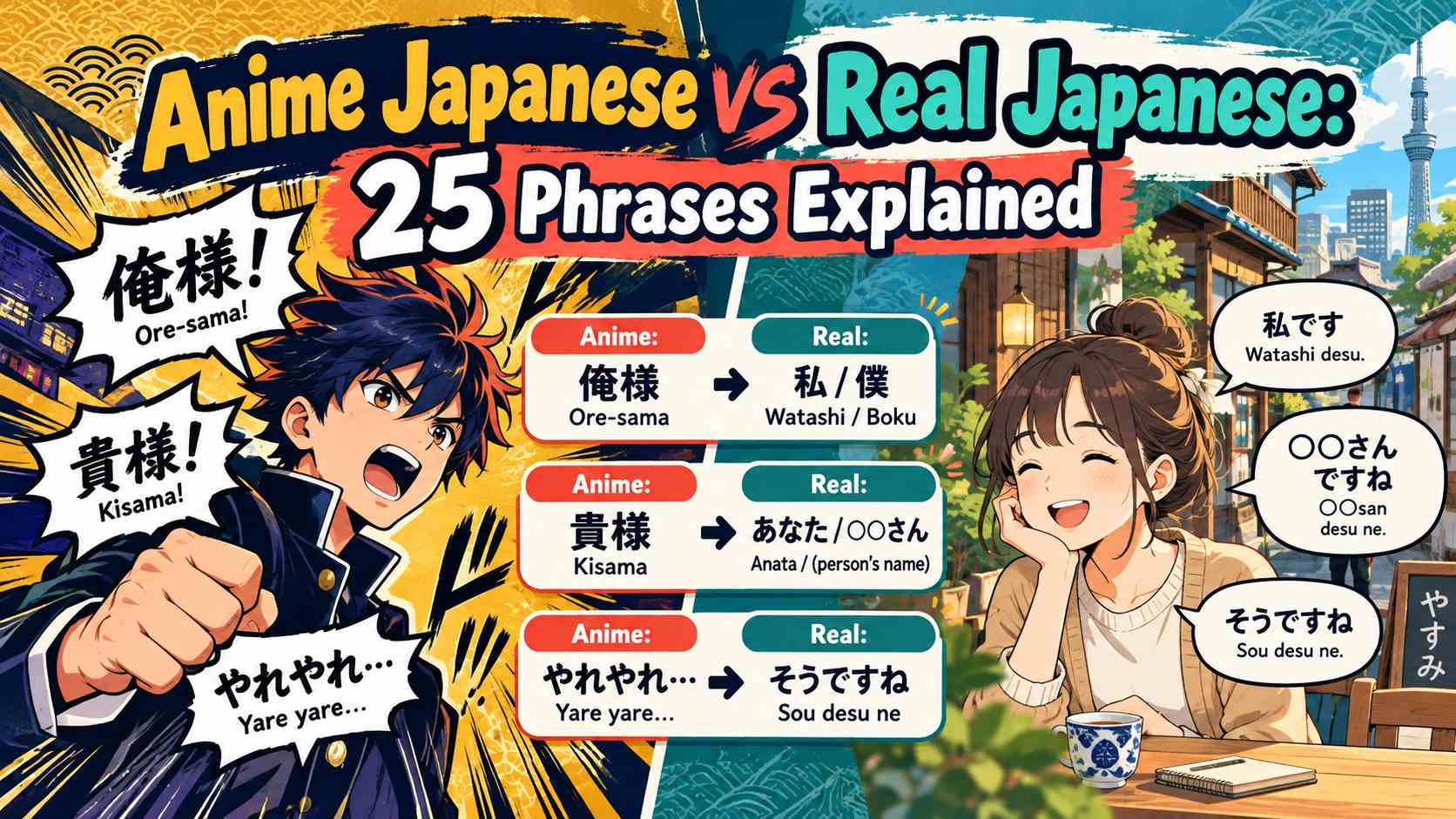
If you have watched enough anime, you already know more Japanese than you think. やった, すごい, かわいい and a dozen others are probably sitting in your head right now, picked up without any studying.
That is a real head start. The catch is that anime dialogue is written to be dramatic, and some of the most memorable lines are things almost nobody says out loud in daily life.
This article walks through 25 expressions you have definitely heard, and tells you honestly what each one sounds like to a Japanese ear. None of it is forbidden. It is about knowing what a line signals before you say it.
Why Anime Japanese Sounds Different
Anime is fiction, and fictional dialogue does a job that ordinary conversation does not. Characters need to be distinguishable in one line of speech, so writers give them strong pronouns, distinctive sentence endings, and a tendency to say things out loud that a real person would leave unsaid.
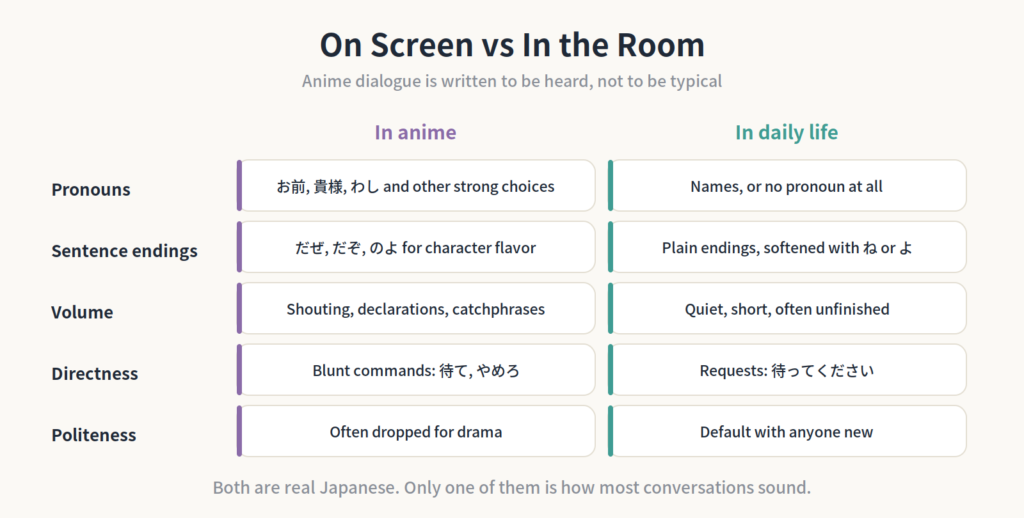
Everyday Japanese tends to go the other way: shorter, softer, and often trailing off before the sentence is finished. Neither version is fake. They just serve different purposes.
Understanding a line is always safe. Saying it is the part that depends on context.
The Quick Overview
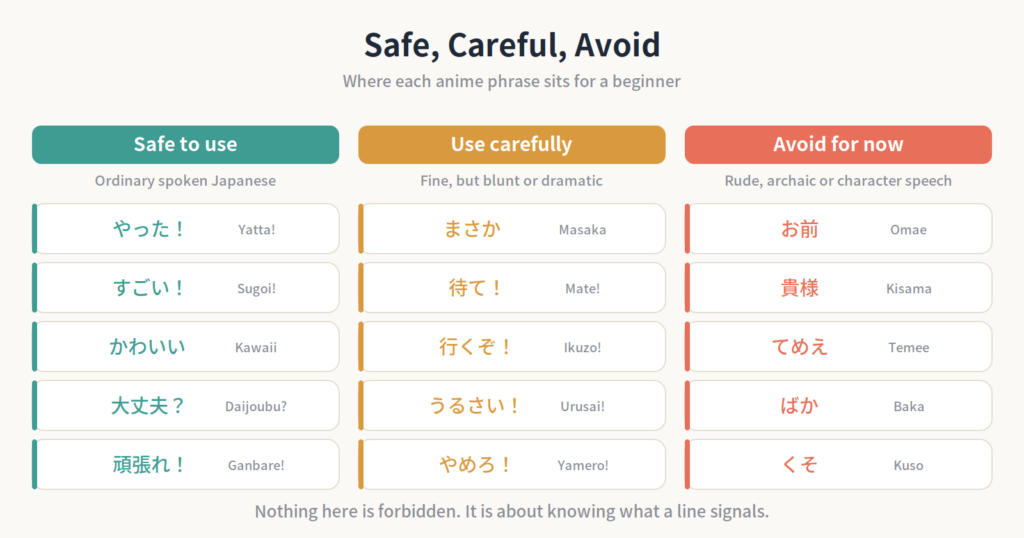
Here is where the 25 expressions fall. Details for each one follow below.
| Group | What it means for you |
|---|---|
| Safe | Ordinary spoken Japanese. Say these freely with friends. |
| Careful | Real, but blunt, dramatic, or situation-specific. |
| Avoid for now | Rude, archaic, or tied to a character type. Understand them, don’t use them yet. |
Group 1: Safe to Use (8 phrases)
These come straight out of anime and straight into real conversation with no adjustment needed.
| Japanese | Meaning, tone and usage |
|---|---|
| やった! Yatta! | I did it! / Yes! Anime: victory shouts. Real life: exactly the same, when something goes well. Tone: happy, casual. Beginner: yes. |
| すごい! Sugoi! | Amazing! / Wow! Anime: reaction to anything impressive. Real life: extremely common, all ages. Tone: positive, casual. Beginner: yes. |
| かわいい Kawaii | Cute. Anime: characters, animals, objects. Real life: used constantly, and not only about people. Tone: warm, casual. Beginner: yes. |
| 大丈夫? Daijoubu? | Are you okay? Anime: after someone falls or gets hurt. Real life: identical, plus “is this okay?” Tone: caring, neutral. Beginner: yes. |
| 頑張れ! Ganbare! | Do your best! / Hang in there! Anime: cheering someone on. Real life: the same, though 頑張って (ganbatte) is softer. Tone: encouraging. Beginner: yes, prefer ganbatte with people you don’t know well. |
| うそ! Uso! | No way! (literally “lie”) Anime: shock. Real life: a normal reaction to surprising news. Tone: surprised, casual. Beginner: yes, among friends. |
| なるほど Naruhodo | I see. / That makes sense. Anime: the clever character working something out. Real life: very common, including at work. Tone: neutral. Beginner: yes. |
| やばい Yabai | Crazy / awful / amazing, depending on context. Anime: usually “this is bad.” Real life: slang that swings both ways, very common with younger speakers. Tone: casual slang. Beginner: yes with friends, not in formal settings. |
Group 2: Use Carefully (9 phrases)
All of these are real Japanese. What makes them tricky is that they are blunt commands, dramatic reactions, or tied to a specific moment.
| Japanese | Meaning, tone and usage |
|---|---|
| まさか Masaka | No way. / It can’t be. Anime: the dramatic realization. Real life: used, but far less theatrically. Tone: disbelief. Beginner: fine, just say it more quietly than an anime character would. |
| 何!? Nani!? | What!? Anime: shouted at a shocking reveal. Real life: 何 is an ordinary word, but shouting it at someone is confrontational. Tone: ranges from neutral to aggressive. Beginner: use なに? softly, not as a shout. |
| 待て! Mate! | Wait! Anime: stopping someone mid-escape. Real life: a blunt command. 待って (matte) or 待ってください is normal. Tone: commanding. Beginner: use 待って instead. |
| 行くぞ! Ikuzo! | Let’s go! Anime: rallying the team. Real life: heard among close friends, with a rough masculine flavor from ぞ. Tone: energetic, rough. Beginner: 行こう (ikou) is the neutral version. |
| やめろ! Yamero! | Stop it! Anime: during a fight. Real life: a harsh command, genuinely confrontational. Tone: angry. Beginner: やめて (yamete) is what you actually want. |
| うるさい! Urusai! | You’re loud! / Shut up! Anime: comic or angry retort. Real life: can be playful between friends, rude to anyone else. Tone: irritated. Beginner: only with close friends who know you’re joking. |
| しかたない Shikata nai | It can’t be helped. Anime: reluctant acceptance. Real life: extremely common and quite useful. Tone: resigned, neutral. Beginner: yes, but it can sound dismissive about someone else’s problem. |
| 任せて Makasete | Leave it to me. Anime: confident declaration. Real life: normal, though it does promise something. Tone: confident, casual. Beginner: yes, if you can deliver. |
| 絶対 Zettai | Absolutely / definitely / never. Anime: dramatic promises. Real life: common, but a strong word that commits you. Tone: emphatic. Beginner: yes, used sparingly. |
Careful: Japanese command forms ending in -ろ or -え (やめろ, 待て) are much harsher than their English translations look. The -て form is the everyday version and is what you want in almost every situation.
Group 3: Avoid for Now (8 phrases)
Worth recognizing, not worth repeating. Several of these are rude, and a few are essentially costume pieces: they mark a character type rather than communicate anything extra.
| Japanese | Meaning, tone and usage |
|---|---|
| お前 Omae | You. Anime: everywhere, from rivals to close friends. Real life: blunt. Fine between some close friends, insulting to a stranger. Tone: rough or intimate. Beginner: no. Use the person’s name. |
| 貴様 Kisama | You (hostile). Anime: villains and enemies. Real life: archaic and openly aggressive. Tone: hostile. Beginner: never. |
| てめえ Temee | You (very rough). Anime: the moment before a fight. Real life: picking a fight. Tone: aggressive. Beginner: never. |
| ばか Baka | Idiot. Anime: often affectionate teasing. Real life: depends entirely on the relationship and the tone. Easy to get wrong. Tone: playful to genuinely insulting. Beginner: no, not until you can read the room. |
| くそ Kuso | Damn. / Crap. Anime: frustration. Real life: crude. Muttered to oneself, not said to people. Tone: vulgar. Beginner: no. |
| ふざけるな Fuzakeru na | Don’t mess with me. / You’ve got to be kidding. Anime: anger. Real life: a serious confrontation. Tone: angry. Beginner: no. |
| わし Washi | I / me. Anime: elderly characters and some regional speakers. Real life: exists, but on you it will sound like a costume. Tone: old-fashioned. Beginner: no. 私 (watashi) is the safe choice. |
| 〜だぜ / 〜だぞ -daze / -dazo | Sentence endings adding swagger. Anime: marks a confident, rough-talking character. Real life: rare, and noticeable when a learner uses it. Tone: boastful, masculine. Beginner: no. Plain endings or ね and よ are natural. |
The “You” Problem
Anime makes Japanese look like it has a dozen words for “you,” each with a different attitude. That part is true. What anime does not show is how rarely any of them get used.
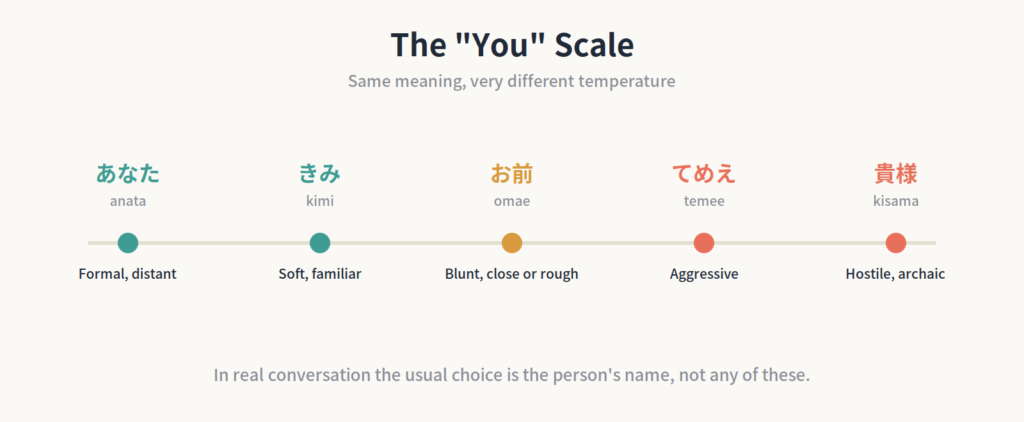
In ordinary conversation, Japanese speakers mostly use the person’s name, or simply leave the subject out because context makes it obvious. Reaching for a “you” word at all is already a choice, and the wrong one lands hard.
Careful: If you are unsure which “you” to use, the answer is usually that you don’t need one. Use their name, or drop the subject entirely.
A Filter for Any New Phrase
You will keep picking up expressions from anime, which is a good thing. Three quick questions will tell you whether a line is safe to borrow.
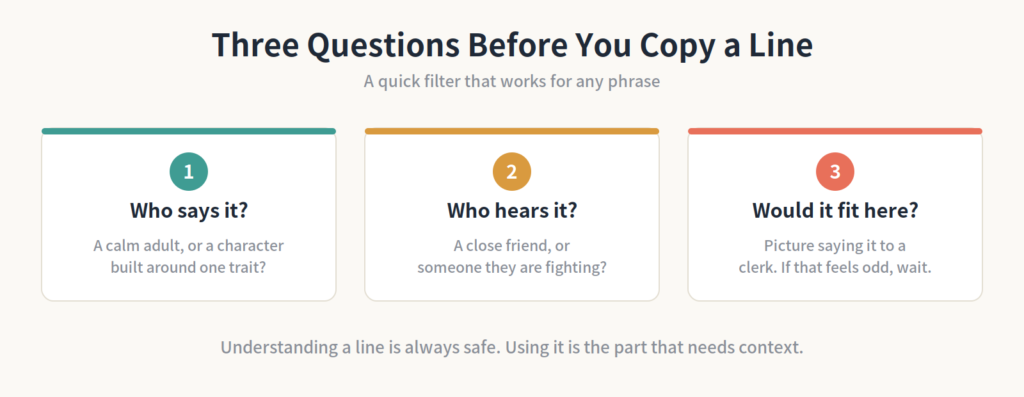
The third question does most of the work. Picture saying the line to a convenience store clerk. If that feels absurd, the phrase is character speech, not everyday Japanese.
Recognition Quiz
Six quick questions. Answer before scrolling.
- Which is safe to say to a classmate you just met: すごい or てめえ?
- You want someone to wait. Is 待て or 待って the better choice?
- What does うそ literally mean, and what does it mean as a reaction?
- Which of these signals a hostile relationship: きみ or 貴様?
- Is やばい positive or negative?
- A character says 行くぞ. What is the neutral everyday version?
Answers
- すごい. てめえ is close to starting a fight.
- 待って. 待て is a blunt command.
- It literally means “lie,” and it works like “no way!” as a reaction.
- 貴様. きみ is soft and familiar.
- Both. Context and tone decide, which is exactly what makes it slang.
- 行こう (ikou).
How to Actually Learn Japanese With Anime
- Treat anime as listening practice and a vocabulary source, not as a model for how to speak.
- Notice who says what. Register is carried by the character, so the same word from two characters means two different things.
- Pay attention to calm scenes. Conversations at home or in a classroom are far closer to real speech than battle dialogue.
- Look phrases up before using them. A dictionary entry will usually flag rough or archaic words.
- Pair it with something structured. Anime gives you vocabulary and ear training; it will not give you grammar in order.
Being able to hear a line and know it is character speech is a real skill, and it comes faster than most people expect. It also makes rewatching things surprisingly fun.
From Watching to Actually Using It
If anime has left you curious about doing something with Japanese rather than only hearing it, entering Japanese yourself is a good next move. Our Japanese typing game is one way to try that: you handle practical Japanese words while playing, through the virtual Japanese keyboard built into the app.
Nothing on your phone needs changing first. Your system language stays as it is, and your normal keyboard is untouched. QWERTY romaji input is there if you want something familiar, and Japanese flick input is available when you feel like trying the layout used across Japan.
