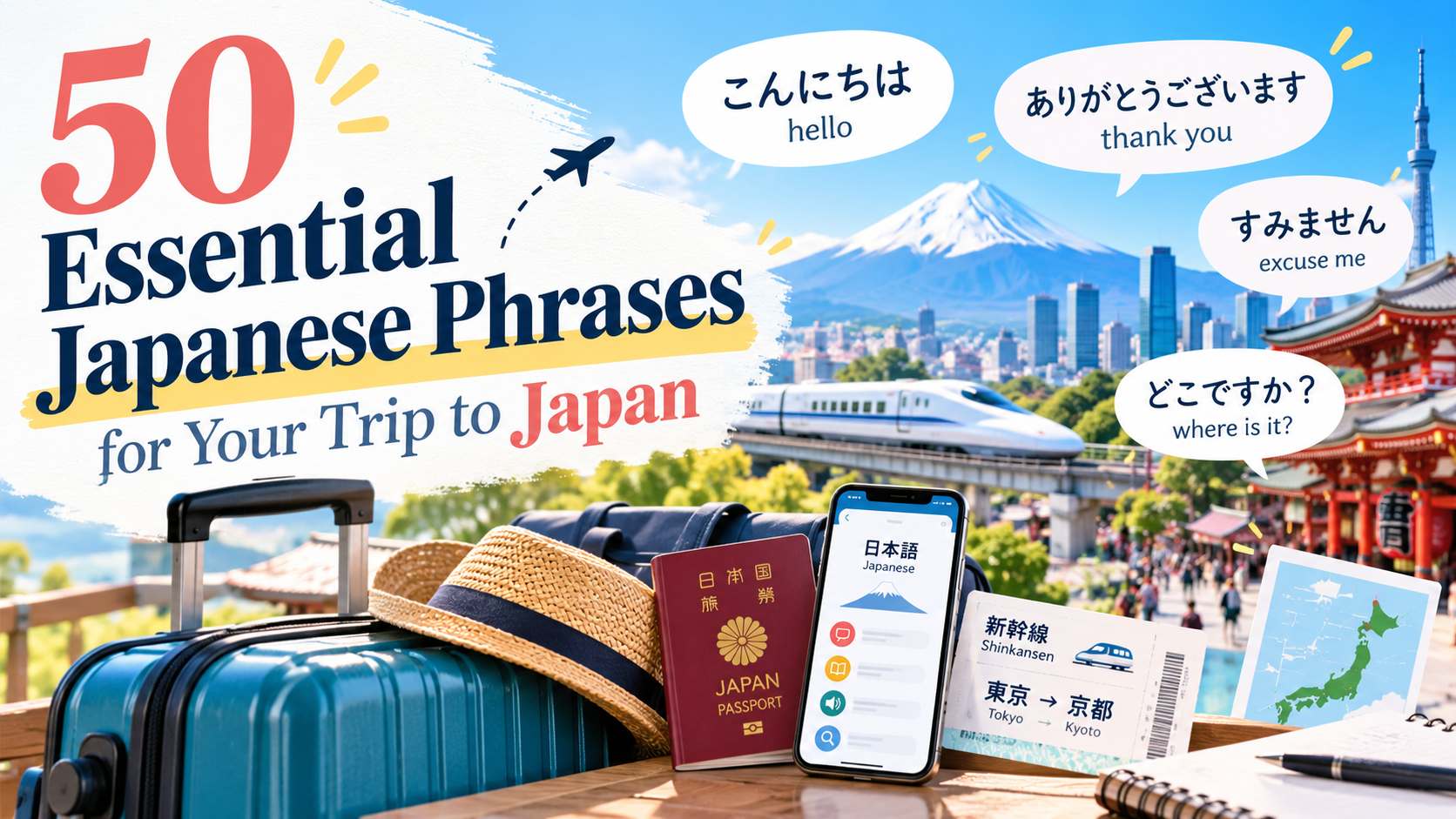
You can have a great trip to Japan without speaking any Japanese. Signs are bilingual in the places tourists go, staff are patient, and translation apps do a decent job.
But a handful of phrases changes the experience. Ordering without pointing at a screen, asking a stranger for directions and understanding the answer, thanking a shop owner properly. These small moments are what people remember about a trip.
Below are 50 Japanese travel phrases, grouped by the situation you will actually use them in. Each one includes the Japanese, the romaji, the natural English meaning, and a note on when to say it.
Before You Start: Two Things Worth Knowing
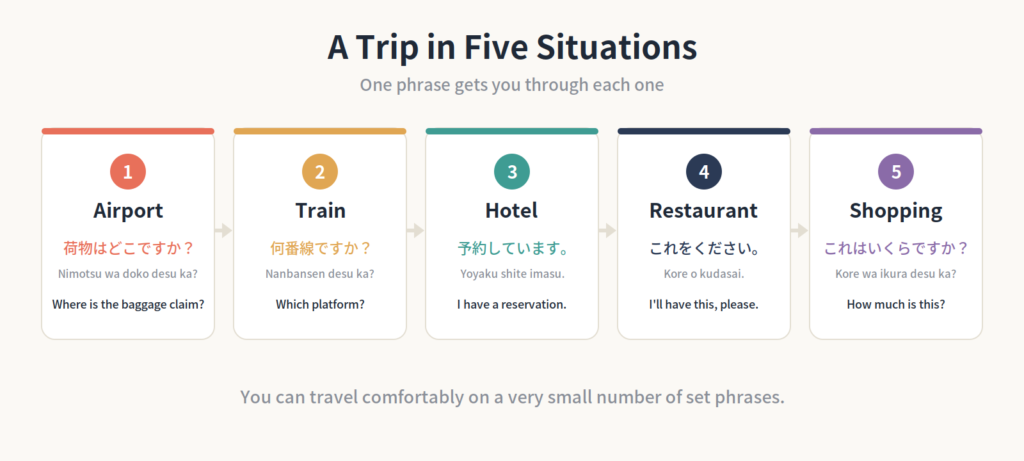
First, Japanese politeness is mostly built into the ending of a sentence, not into complicated grammar. Almost every phrase here ends in です (desu), ですか (desu ka), ください (kudasai), or お願いします (onegaishimasu). Those endings do the polite work for you, which is why you can stay polite with zero grammar study.
Second, nobody expects a tourist to be fluent. A short phrase said clearly is more useful than a long sentence said hesitantly, and staff will usually meet you halfway.
Point at the thing, say the phrase, add お願いします. That pattern alone handles most transactions in Japan.
Basic Greetings (6 phrases)
| Japanese | English and when to use it |
|---|---|
| こんにちは Konnichiwa | Hello. / Good afternoon. Safe from late morning until evening. Not used first thing in the morning. |
| おはようございます Ohayou gozaimasu | Good morning. Say this to hotel staff at breakfast. Drop gozaimasu only with friends. |
| ありがとうございます Arigatou gozaimasu | Thank you. The full polite form. Use it with anyone serving you. |
| すみません Sumimasen | Excuse me. / Sorry. The single most useful word on this page. See the next section. |
| はい / いいえ Hai / Iie | Yes. / No. In practice はい is also a general “I’m listening” signal. |
| お願いします Onegaishimasu | Please. / Yes, please. Tack it onto almost any request to make it polite. |
When to Use すみません
If you only memorize one word before flying to Japan, make it this one. すみません does three separate jobs, and Japanese people use it constantly.
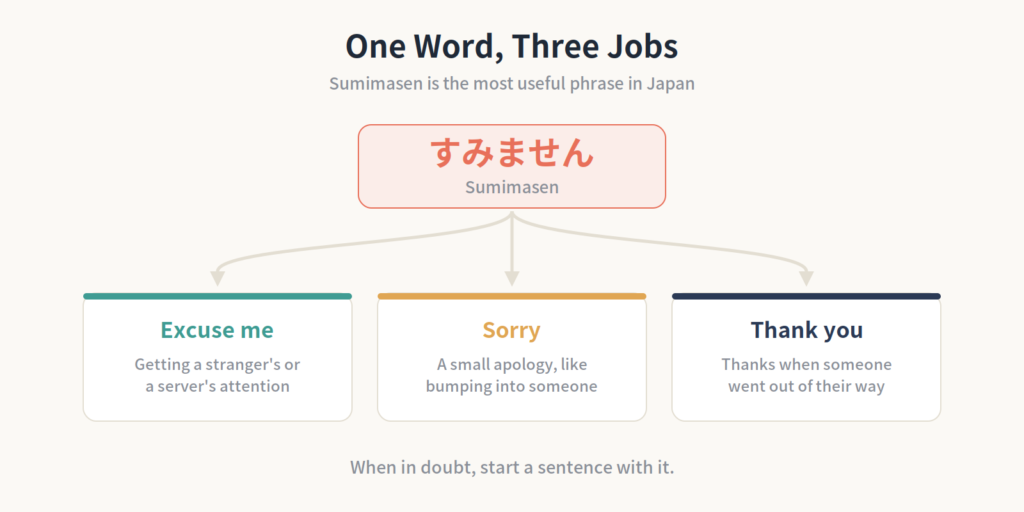
Use it to call a server over, to squeeze past someone on a crowded train, to apologize for bumping into a stranger, and to thank someone who went out of their way for you. Starting any question with it also softens the whole sentence.
At the Airport (5 phrases)
| Japanese | English and when to use it |
|---|---|
| 観光です。 Kankou desu. | I’m here for sightseeing. The standard answer at immigration when asked your purpose. |
| 荷物はどこですか? Nimotsu wa doko desu ka? | Where is the baggage claim? Works for luggage in general, not only the carousel. |
| 両替はどこですか? Ryougae wa doko desu ka? | Where can I exchange money? Ryougae is the word printed on exchange counters. |
| タクシー乗り場はどこですか? Takushii noriba wa doko desu ka? | Where is the taxi stand? Noriba means boarding area, so it also works for buses. |
| Wi-Fiはありますか? Waifai wa arimasu ka? | Is there Wi-Fi? The arimasu ka pattern asks whether anything is available. |
Trains and Subways (5 phrases)
| Japanese | English and when to use it |
|---|---|
| 切符はどこで買えますか? Kippu wa doko de kaemasu ka? | Where can I buy a ticket? Useful when the machines look intimidating. |
| この電車は新宿に行きますか? Kono densha wa Shinjuku ni ikimasu ka? | Does this train go to Shinjuku? Swap in any station name. Staff on the platform will answer. |
| 何番線ですか? Nanbansen desu ka? | Which platform? Short and very common. Expect a number in reply. |
| 次は何駅ですか? Tsugi wa nani eki desu ka? | What’s the next station? Handy when announcements are hard to catch. |
| 東京駅までお願いします。 Toukyou eki made onegaishimasu. | To Tokyo Station, please. The standard way to tell a taxi driver your destination. |
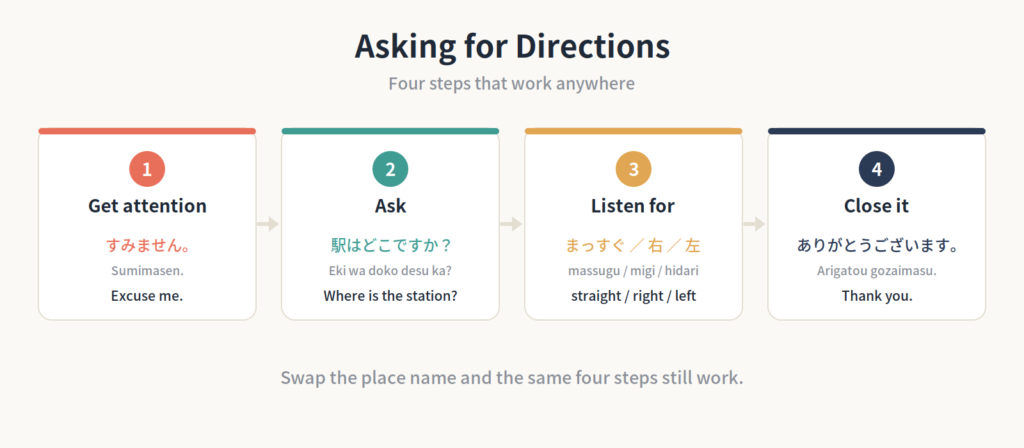
Asking for Directions (5 phrases)
Asking is the easy half. Understanding the answer is what trips people up, so learn the three direction words along with the questions.
| Japanese | English and when to use it |
|---|---|
| 駅はどこですか? Eki wa doko desu ka? | Where is the station? Replace eki with any place: toire, konbini, basu tei. |
| トイレはどこですか? Toire wa doko desu ka? | Where is the restroom? Worth memorizing separately. You will use it. |
| ここはどこですか? Koko wa doko desu ka? | Where am I? Best said while holding out a map or your phone screen. |
| 歩いて行けますか? Aruite ikemasu ka? | Can I walk there? A quick way to find out if you need a train or taxi. |
| まっすぐ / 右 / 左 massugu / migi / hidari | straight / right / left Not a phrase, but the three words you need to catch in the answer. |
At the Hotel (5 phrases)
| Japanese | English and when to use it |
|---|---|
| チェックインお願いします。 Chekku in onegaishimasu. | I’d like to check in. Say it at the front desk and hand over your passport. |
| 予約しています。 Yoyaku shite imasu. | I have a reservation. Natural follow-up to the phrase above. |
| 荷物を預かってもらえますか? Nimotsu o azukatte moraemasu ka? | Could you hold my luggage? For early arrivals and late checkouts. Almost always yes. |
| 何時にチェックアウトですか? Nanji ni chekku auto desu ka? | What time is checkout? Nanji means “what time” and works in many other questions. |
| 部屋の鍵をなくしました。 Heya no kagi o nakushimashita. | I lost my room key. The nakushimashita ending means “I have lost.” Swap the noun as needed. |
At a Restaurant (6 phrases)
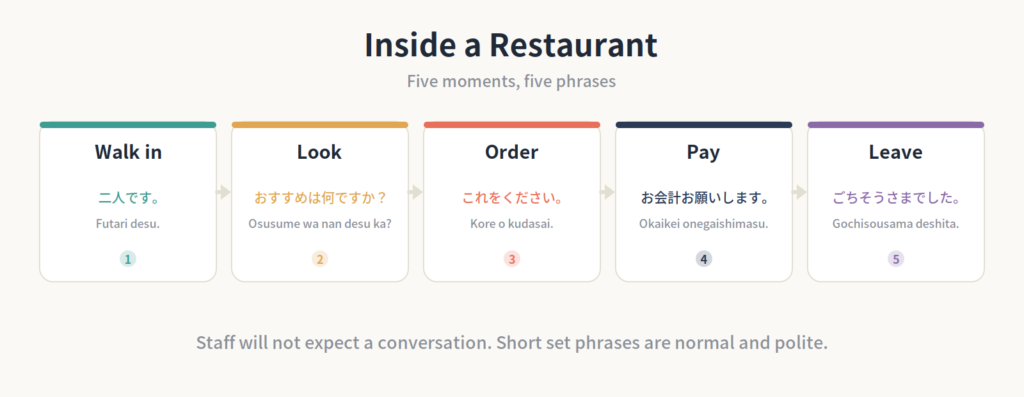
Restaurants follow a predictable script in Japan, which makes them one of the easiest places to use Japanese. You will often be greeted with いらっしゃいませ (irasshaimase), which means welcome. You are not expected to answer it.
| Japanese | English and when to use it |
|---|---|
| 二人です。 Futari desu. | Two people. Say it on entering. Hitori is one, san-nin is three. |
| メニューをお願いします。 Menyuu o onegaishimasu. | Menu, please. Also works for an English menu: eigo no menyuu. |
| おすすめは何ですか? Osusume wa nan desu ka? | What do you recommend? A genuinely good question in small local places. |
| これをください。 Kore o kudasai. | I’ll have this, please. Point at the menu while you say it. Nothing rude about that here. |
| お会計お願いします。 Okaikei onegaishimasu. | Check, please. In many places you pay at the register rather than the table. |
| ごちそうさまでした。 Gochisousama deshita. | Thank you for the meal. Said on the way out. It always lands well. |
At a Convenience Store (4 phrases)
| Japanese | English and when to use it |
|---|---|
| 袋をください。 Fukuro o kudasai. | Could I have a bag? Bags usually cost a few yen and are no longer automatic. |
| 温めてください。 Atatamete kudasai. | Please heat it up. For bento and anything else from the chilled shelf. |
| カードで払えますか? Kaado de haraemasu ka? | Can I pay by card? Usually yes in cities, less certain in rural areas. |
| レシートをください。 Reshiito o kudasai. | Receipt, please. Useful if you are tracking spending or claiming tax back. |
Shopping (5 phrases)
| Japanese | English and when to use it |
|---|---|
| これはいくらですか? Kore wa ikura desu ka? | How much is this? The classic shopping question. Ikura always means price. |
| 見ているだけです。 Mite iru dake desu. | I’m just looking. A polite way to decline help without ending the conversation rudely. |
| 試着できますか? Shichaku dekimasu ka? | Can I try this on? Expect to remove your shoes in some fitting rooms. |
| もう少し大きいサイズはありますか? Mou sukoshi ookii saizu wa arimasu ka? | Do you have a larger size? Swap ookii for chiisai to ask for smaller. |
| 免税できますか? Menzei dekimasu ka? | Is tax-free shopping available? Bring your passport. Rules and minimum amounts change, so ask. |
Asking for Help (4 phrases)
| Japanese | English and when to use it |
|---|---|
| 英語が話せますか? Eigo ga hanasemasu ka? | Do you speak English? Ask it after すみません rather than as an opener. |
| もう一度お願いします。 Mou ichido onegaishimasu. | Could you say that again? Far more useful than pretending you understood. |
| ゆっくりお願いします。 Yukkuri onegaishimasu. | Please speak slowly. People will genuinely slow down if you ask. |
| わかりません。 Wakarimasen. | I don’t understand. Honest and completely acceptable. Nobody minds. |
Emergencies (5 phrases)
You will probably never need these. Learn them anyway, because they are the phrases you cannot look up calmly when you actually need them.
| Japanese | English and when to use it |
|---|---|
| 助けて! Tasukete! | Help! Shout it. This is the one phrase where politeness does not apply. |
| 警察を呼んでください。 Keisatsu o yonde kudasai. | Please call the police. Yonde kudasai means “please call.” The noun in front changes. |
| 救急車を呼んでください。 Kyuukyuusha o yonde kudasai. | Please call an ambulance. Same pattern as above, for a medical emergency. |
| 病院はどこですか? Byouin wa doko desu ka? | Where is a hospital? Same doko desu ka pattern you already know. |
| 財布をなくしました。 Saifu o nakushimashita. | I lost my wallet. Lost property in Japan is often handed in. Report it at a police box. |
How to Actually Remember These
Fifty phrases is a lot to carry onto a plane. A better approach is to pick the ones matching what you will do first.
- Learn すみません, ありがとうございます, and お願いします until they are automatic. That is the core.
- Add the one question pattern ~はどこですか (where is ~), which covers dozens of situations by itself.
- Study each situation the night before you need it. Restaurant phrases the evening before your first dinner out.
- Say them out loud. Reading silently will not get them to come out under pressure.
Three words and one question pattern will carry you further than forty memorized sentences you cannot recall in the moment.
Enjoy the Small Moments
Using a phrase and having it work is a small thrill, and it tends to be contagious. Plenty of people come back from Japan having decided to keep studying, entirely because of a few successful exchanges in a shop.
If that happens to you, hiragana is the natural next step, and it is far less work than it looks.
Curious Enough to Try Typing It?
Once Japanese starts to interest you, reading about it stops being enough. Our Japanese typing game is one easy way to go further: you enter real Japanese yourself and work with practical Japanese words while you play, using the virtual Japanese keyboard built into the app.
There is nothing to configure beforehand. Your phone’s language settings stay exactly as they are, and your usual keyboard is left alone. Use QWERTY romaji if you want something familiar, or try Japanese flick input, the swipe-based layout people use across Japan.
