A small number of words does a huge amount of work in any language. In Japanese, a few hundred common words will carry you through most everyday situations, and the first hundred are the ones you will hear again and again.
This list is exactly 100 basic Japanese words, sorted into categories you can actually use. Every entry has the Japanese, the romaji, and a natural English meaning. Nothing rare or academic made the cut.
How to Use This List
Do not try to memorize all 100 words today. That approach feels productive for about twenty minutes and then falls apart.
Instead, work through one category at a time. Each group below is small enough to finish in a single sitting, and grouping words by meaning makes them easier to recall than a random alphabetical list.
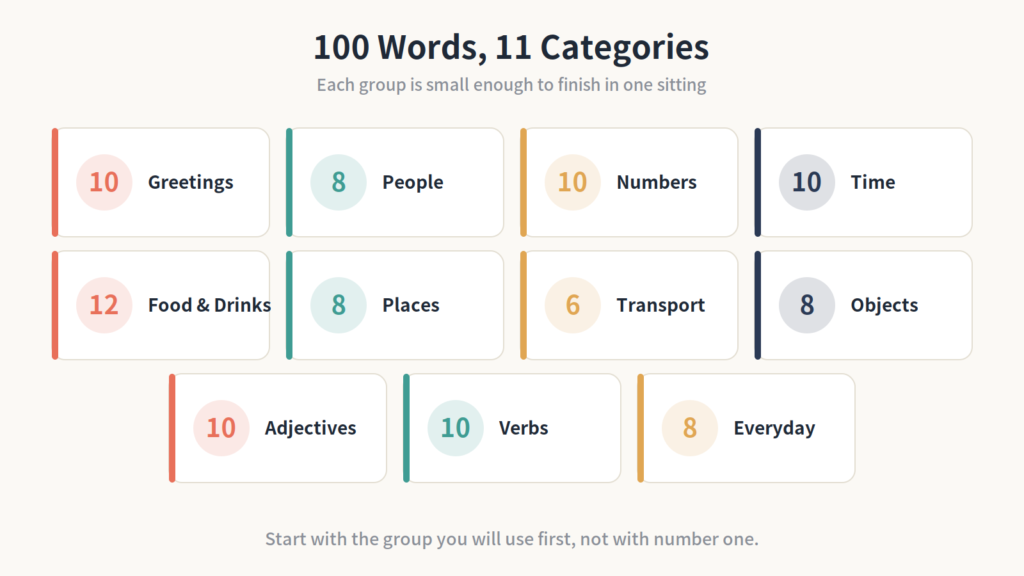
You also do not have to start at the top. If you are planning a trip, start with places and transportation. If you are watching a lot of Japanese shows, start with the greetings and everyday words.
Ten words you can actually use beat fifty words you half-remember.
Greetings and Polite Words (10)
| Japanese | Romaji | Meaning |
|---|---|---|
| こんにちは | konnichiwa | hello / good afternoon |
| おはよう | ohayou | good morning |
| こんばんは | konbanwa | good evening |
| さようなら | sayounara | goodbye |
| ありがとう | arigatou | thank you |
| すみません | sumimasen | excuse me / sorry |
| ごめんなさい | gomennasai | I’m sorry |
| はい | hai | yes |
| いいえ | iie | no |
| おねがいします | onegaishimasu | please |
A note on politeness: adding ございます (gozaimasu) after おはよう or ありがとう makes them more formal. Use the longer forms with strangers and staff, and the short forms with friends.
すみません is the most useful word in this table. It works as “excuse me,” “sorry,” and “thank you for going out of your way,” depending on the situation.
People (8)
| Japanese | Romaji | Meaning |
|---|---|---|
| 私 | watashi | I / me |
| あなた | anata | you |
| 人 | hito | person |
| 友達 | tomodachi | friend |
| 家族 | kazoku | family |
| お母さん | okaasan | mother |
| お父さん | otousan | father |
| 先生 | sensei | teacher |
あなた is textbook Japanese for “you,” but in real conversation people usually use the other person’s name instead. 先生 is also used for doctors and other professionals, not only school teachers.
Numbers (10)
| Japanese | Romaji | Meaning |
|---|---|---|
| 一 | ichi | one |
| 二 | ni | two |
| 三 | san | three |
| 四 | yon / shi | four |
| 五 | go | five |
| 六 | roku | six |
| 七 | nana / shichi | seven |
| 八 | hachi | eight |
| 九 | kyuu / ku | nine |
| 十 | juu | ten |
Four, seven, and nine each have two readings. When you are counting out loud, yon, nana, and kyuu are the safer choices.
Time (10)
| Japanese | Romaji | Meaning |
|---|---|---|
| 今 | ima | now |
| 今日 | kyou | today |
| 明日 | ashita | tomorrow |
| 昨日 | kinou | yesterday |
| 朝 | asa | morning |
| 昼 | hiru | noon / daytime |
| 夜 | yoru | night |
| 時間 | jikan | time / hour |
| 週末 | shuumatsu | weekend |
| 毎日 | mainichi | every day |
These words let you talk about when something happens long before you learn any verb tenses, which is why they are worth an early look.
Food and Drinks (12)
| Japanese | Romaji | Meaning |
|---|---|---|
| 水 | mizu | water |
| お茶 | ocha | tea |
| コーヒー | koohii | coffee |
| ご飯 | gohan | rice / a meal |
| パン | pan | bread |
| 肉 | niku | meat |
| 魚 | sakana | fish |
| 野菜 | yasai | vegetables |
| 果物 | kudamono | fruit |
| 卵 | tamago | egg |
| 寿司 | sushi | sushi |
| ラーメン | raamen | ramen |
ご飯 literally means cooked rice, but it also means “a meal” in general. 朝ご飯 (asagohan) is breakfast, and it is simply “morning” plus “meal.”
Places (8)
| Japanese | Romaji | Meaning |
|---|---|---|
| 家 | ie | house / home |
| 駅 | eki | station |
| 店 | mise | shop / store |
| 学校 | gakkou | school |
| 病院 | byouin | hospital |
| 銀行 | ginkou | bank |
| 公園 | kouen | park |
| トイレ | toire | restroom |
駅 shows up constantly in Japan, both spoken and printed on signs. If you learn one kanji from this whole article, make it that one.
Transportation (6)
| Japanese | Romaji | Meaning |
|---|---|---|
| 電車 | densha | train |
| バス | basu | bus |
| 車 | kuruma | car |
| 自転車 | jitensha | bicycle |
| 飛行機 | hikouki | airplane |
| タクシー | takushii | taxi |
バス and タクシー are written in katakana because they came from English. Once you notice that pattern, a lot of katakana words become easy guesses.
Common Objects (8)
| Japanese | Romaji | Meaning |
|---|---|---|
| 本 | hon | book |
| お金 | okane | money |
| 電話 | denwa | telephone |
| 鍵 | kagi | key |
| かばん | kaban | bag |
| 服 | fuku | clothes |
| 傘 | kasa | umbrella |
| 財布 | saifu | wallet |
The polite お in お金 is part of the normal word. Japanese attaches it to a small set of everyday nouns, and dropping it can sound blunt.
Adjectives (10)
| Japanese | Romaji | Meaning |
|---|---|---|
| 大きい | ookii | big |
| 小さい | chiisai | small |
| 新しい | atarashii | new |
| 古い | furui | old (for things) |
| 高い | takai | expensive / tall |
| 安い | yasui | cheap |
| おいしい | oishii | delicious |
| 楽しい | tanoshii | fun / enjoyable |
| 暑い | atsui | hot (weather) |
| 寒い | samui | cold (weather) |
高い covers both “expensive” and “tall,” and context decides which one you mean. Note also that 古い is used for objects, not for people’s ages.
Verbs (10)
| Japanese | Romaji | Meaning |
|---|---|---|
| 行く | iku | to go |
| 来る | kuru | to come |
| 見る | miru | to see / to watch |
| 食べる | taberu | to eat |
| 飲む | nomu | to drink |
| する | suru | to do |
| 買う | kau | to buy |
| 話す | hanasu | to speak |
| わかる | wakaru | to understand |
| ある | aru | to exist / there is |
These are dictionary forms. In polite conversation they change endings, so 食べる becomes 食べます (tabemasu). Learning the dictionary form first is still the right move, because that is how words are listed everywhere.
Useful Everyday Words (8)
| Japanese | Romaji | Meaning |
|---|---|---|
| 何 | nani | what |
| 誰 | dare | who |
| どこ | doko | where |
| いつ | itsu | when |
| いくら | ikura | how much (price) |
| 大丈夫 | daijoubu | okay / fine / no problem |
| 少し | sukoshi | a little |
| とても | totemo | very |
大丈夫 is worth memorizing on its own. It answers “are you okay?”, declines an offer politely, and reassures someone, all with one word.
A Ten-Day Plan for the Whole List
Ten words a day finishes this list in ten days, and ten words is a realistic target for about fifteen minutes of study.
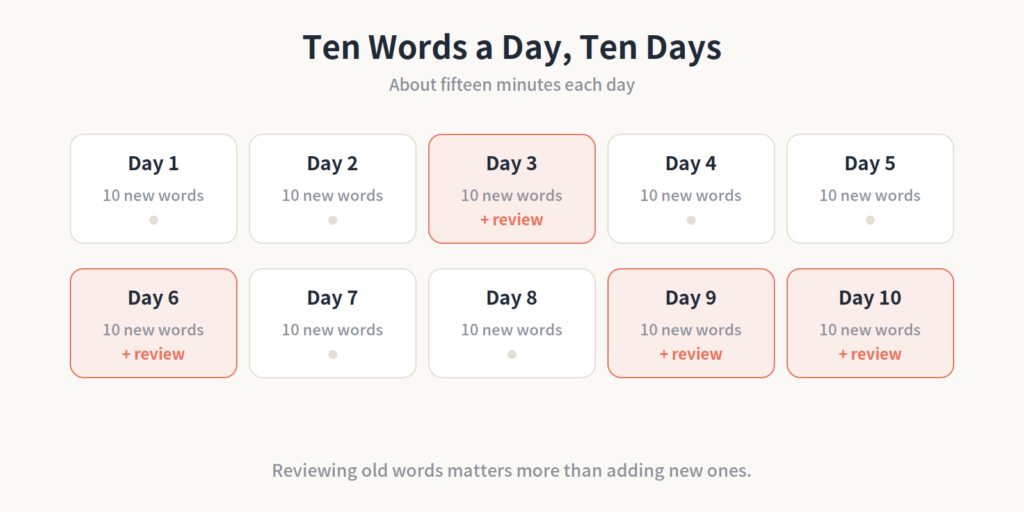
The review days matter more than the new ones. Adding words you never revisit just moves them out of sight. On a review day, cover the English column and see how many you can still produce.
- Study in short sessions rather than one long one.
- Say every word out loud, even when studying alone.
- Keep the words you keep forgetting on a separate short list.
- Missing a day is normal. Pick up where you left off instead of restarting.
See, Read, Type, Review
Recognizing a word and producing it are different skills. Most beginners only practice recognition, then feel stuck when they try to say or write something themselves.
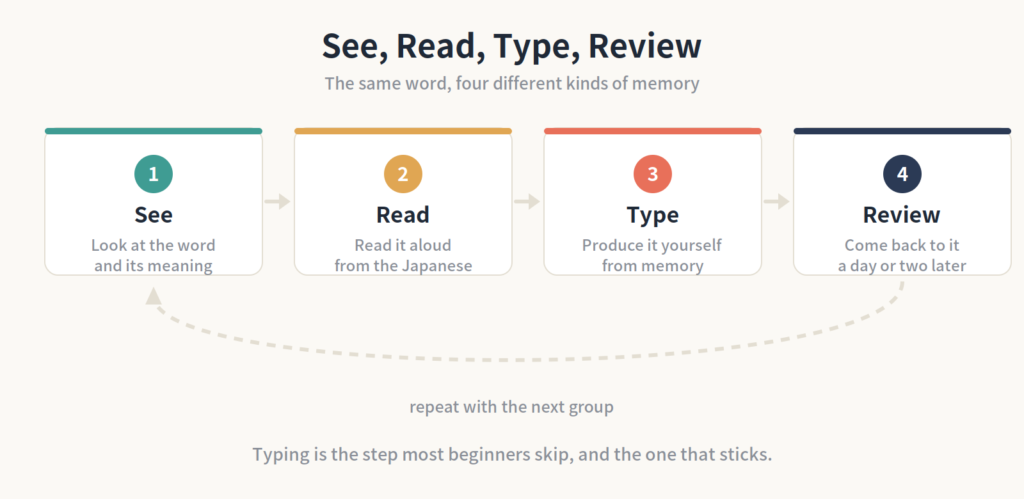
Adding a production step is what closes that gap. Write the word by hand, or type it out, or simply say it while looking only at the English. Any of these forces your memory to do real work.
Quick Quiz
Eight questions drawn from the list above. Answer them before scrolling down.
- What does 駅 (eki) mean?
- How do you say “water” in Japanese?
- What is the difference between 行く (iku) and 来る (kuru)?
- Which word would you use to ask a price?
- What does 友達 (tomodachi) mean?
- How do you say “delicious”?
- What number is 七?
- Which single word can mean “excuse me,” “sorry,” and “thank you”?
Answers
- Station
- 水 (mizu)
- 行く is to go away from here; 来る is to come toward here
- いくら (ikura)
- Friend
- おいしい (oishii)
- Seven (nana or shichi)
- すみません (sumimasen)
What to Do Next
Once a category feels comfortable, use it. Name the objects on your desk in Japanese. Count the stops on your commute. Order your lunch in your head before you order it out loud.
Vocabulary sticks when it gets attached to something you actually do, and these hundred words are common enough that opportunities show up quickly.
Put Some Japanese Words Through Your Fingers
Reading a vocabulary list is passive. Entering Japanese yourself is not, and it is a fast way to find out which words you really know. Our Japanese typing game is one optional way to do that: you type practical Japanese words while you play, using the virtual Japanese keyboard built into the app.
Nothing on your phone needs to change first. Your system language stays as it is, and your usual keyboard settings stay untouched. Type with QWERTY romaji if you want something familiar, or switch to Japanese flick input when you feel like trying the layout people use across Japan.
